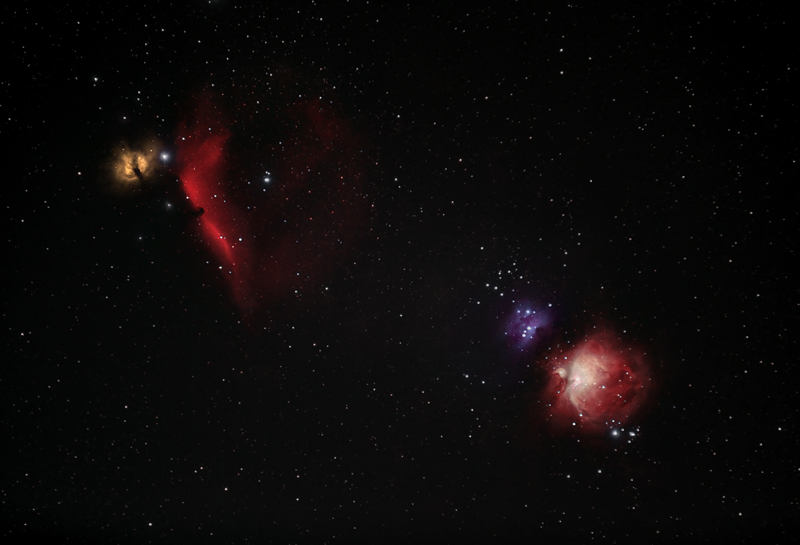
It's been quite a long time since my last deep-sky image submission. So before I forget the basics of astrophotography I gave the first try with my great new lens and The result is promising for sure!
I wish I could use more than 10 exposures for the final image. Anyway, details of acquiring and processing the frames follows:
Mount : AstroTrac TT320X
- Camera : Canon 1000Da (modified for astrophotography)
- Focal Length : 200mm
- Exposures : a) 3 x 90 sec at f2.8 and ISO 800
b) 6 x 90 sec at f2.8 and ISO 1600
c) 1 x 10 sec at f2.8 and ISO 800
- FOV : 91.42%
- Alignment, calibration, stacking with DeepSkyStacker
- Further processing with PixInsight LE, PS CS3 and Neat Image.
- Specifically in Photoshop:
Levels
Selective color (4 or 5 times)
Color balance
Curves
Exposure
Noise Reduction
Blending modes (to reveal the details of M42 core with the individual exposure of 10 sec)
Clone out quite lot of hot pixels that were previously enhanced due to processing.
Statistics
Place: 21 out of 246 Avg (all users): 6.5248 Avg (commenters): 7.9000 Avg (participants): 6.3725 Avg (non-participants): 6.9231 Views since voting: 1827 Views during voting: 246 Votes: 141 Comments: 13 Favorites: 3 (view)
What a fantastic wide field view not only of the M42 but the Horsehead nebula too, very rich in details and color. Being around astrophotographers in the past, I can relate to the enormous amount of effort that went into making this. Congrats on such a beautiful deep sky image!
Congrats on your finish Paschalis. It's been a while since I've seen something from you. You're a master at this type of work. One of my few 10's. How on Earth do you notice the hot pixels!?







 Add photograph to your favorites
 Add photographer to your favorites

 Photographer found comment helpful.


