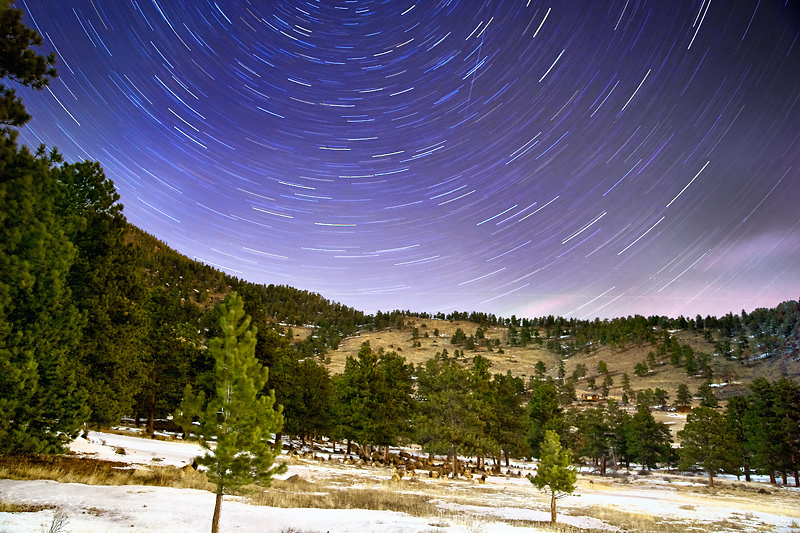
On the down sloping southeast slope of Deer Mountain. Herd of elk laying under the Ponderosa pines. Over more than 30 minutes, the elk move their heads quite a lot. I intended it to be a pastoral landscape scene, not a wildlife detail shot. The terrain is level, as determined by the double bubble level on my hot shoe.
Very generous scores early on. Great comments. Thanks!
Just wanted to remark about my surprise to see the image capture showing day-like exposure because it was very dark. My night vision is excellent, but I could not see the elk herd in the low light conditions of the 24% waxing crescent moon. I had to use my headlamp to set the camera and tripod. But, the camera at wide open aperture and ISO 200 with focus manually set to the hyperfocal distance gave me a deep DOF plane from 20 feet to infinity. The cumulative available light capture produced an acceptable image and a pleasant star trail in the sky. While I'd like to think this was some skill, it was mostly a lucky shot in the dark.
Just to the right of Polaris is a meteor streak. In the lower sky, just above Deer Ridge, are about three airplane streaks.
[Mar. 12th, 2011 05:48:38 AM]
Definitely no "contrails" in this image. The plane light trails and the meteor streak are from emitted light. No "contrails". There were more general clouds over Fort Collins on the right side of the sky. Contributed to the reflection of the light pollution.
11 votes below "5". No comments from those good people.
We are looking at the sloping flank of a mountainside. The ridge saddle is the horizon. Nothing flat about any of this, but it is square and level with the world.
Statistics
Place: 4 out of 39 Avg (all users): 6.8931 Avg (commenters): 8.7143 Avg (participants): 6.7143 Avg (non-participants): 6.9203 Views since voting: 3785 Views during voting: 584 Votes: 159 Comments: 29 Favorites: 1 (view)
Nice photo. I don't have the skill or patience to pull something like this off.
I just got a new tripod with a level and was wondering about your comment:
The terrain is level, as determined by the double bubble level on my hot shoe.
It looks like the horizon and foreground are slanting from left to right. With that in mind, wouldn't the double bubble level be showing that it is your camera that is level and not the terrain?
....
I was at ISO 400 to your 200, and f/5.6 to your f/4.0 — so those cancel each other out. You gave approximately 3 stops more exposure than I did. I was shooting an hour and a half after sunset, and closer to civilization than you, so I expect that gives me a somewhat higher level of ambient light, perhaps a stop's worth. My image was (deliberately) underexposed by a couple stops so as not to blow out the stars, and then brightened in post, so that accounts for the rest of the difference. Here's the resized-but-unaltered RAW:
How does that compare to your unprocessed RAW?
My resized-but-unaltered RAW: I agree with your comparison analysis.
excellent shot, and the "surprize" herd of elk is just an icing on the cake. congratulations!
(it must have been pretty dark there for such a long exposure at f/4. compare that with 180s in Robert's shot with f/5.6... and also moonlit, presumably by the same moon :)... do you understand it?)
No, not entirely! I was shooting after the end of astronomical twilight. It was very dark. Maybe Robert had some twilight left.... or light pollution from civilization on the East coast. The ONLY source of my light was the waxing crescent 24% moon. Had I used 180s, I would have had very little exposure. Mystery to me! I could not see the light pollution from Fort Collins, but it registered on the sensor.
I was at ISO 400 to your 200, and f/5.6 to your f/4.0 — so those cancel each other out. You gave approximately 3 stops more exposure than I did. I was shooting an hour and a half after sunset, and closer to civilization than you, so I expect that gives me a somewhat higher level of ambient light, perhaps a stop's worth. My image was (deliberately) underexposed by a couple stops so as not to blow out the stars, and then brightened in post, so that accounts for the rest of the difference. Here's the resized-but-unaltered RAW:
Very well done Richard. Can't for the life of me figure out how you could get anything less than a 6 on this. I think it's due to maybe voters think this technique is supposed to be easy or something. Anyway, congrats on an outstanding image, I knew this was yours the second I saw it! Outstanding effort with going out in the middle of the night to do this.
excellent shot, and the "surprize" herd of elk is just an icing on the cake. congratulations!
(it must have been pretty dark there for such a long exposure at f/4. compare that with 180s in Robert's shot with f/5.6... and also moonlit, presumably by the same moon :)... do you understand it?)
No, not entirely! I was shooting after the end of astronomical twilight. It was very dark. Maybe Robert had some twilight left.... or light pollution from civilization on the East coast. The ONLY source of my light was the waxing crescent 24% moon. Had I used 180s, I would have had very little exposure. Mystery to me! I could not see the light pollution from Fort Collins, but it registered on the sensor.
excellent shot, and the "surprize" herd of elk is just an icing on the cake. congratulations!
(it must have been pretty dark there for such a long exposure at f/4. compare that with 180s in Robert's shot with f/5.6... and also moonlit, presumably by the same moon :)... do you understand it?)
I had a feeling this shot was yours... Really a wonderful image. Congrats on the top 5! oh and thanks for posting all the info on your shot, helps us noobs try to figure this night gig out...
Fairly incredible. Something about it makes me want to shake it left, but then we'd have even more star trails. Fantastic capture. Exposure is true to day, yet those stars... awesome. And a herd of deer? Elk? Wow. An unexpected benefit of this theme. Excellent.
A fascinating scene highlighting the beauty of nature. Multiple contrails denote the presence of man. As a critique, I think you could have leveraged the location of Polaris in avoiding a pseudo-centered composition. 7
Very impressive -- my favorite of the bunch! This really does a great job of doing what the challenge suggested -- looking like daylight while keeping elements of night. I expect to see a ribbon on this one.
I would love to see a more interesting foreground but the exposure is nice and I really love the star trails and how the curvature matches nicely with the tree line. Well done.





 Add photograph to your favorites
 Add photographer to your favorites

 Photographer found comment helpful.