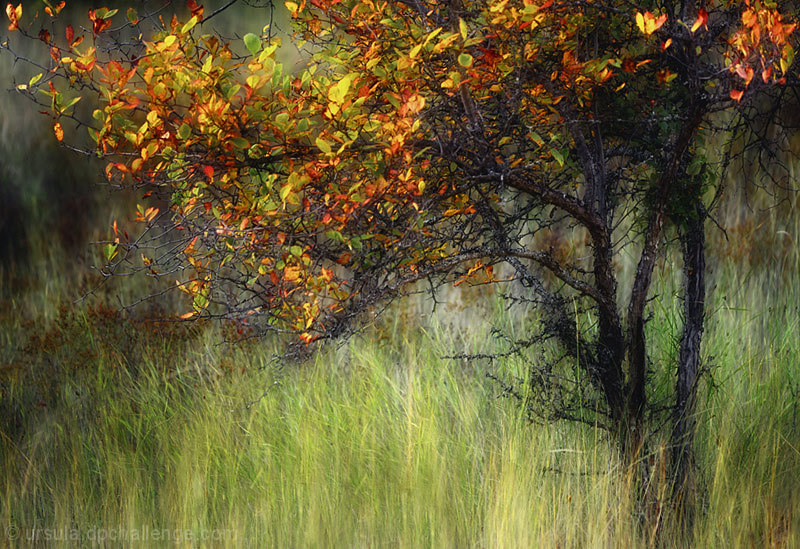
I've been experimenting with HDR, and in particular with HDR and shallow DOF. This is a picture created from a series of 5 bracketed exposures, shot RAW, tripod, macro lens fully open, warming polarizer.
The 5 exposures were converted to an HDR file and tonemapped in Photomatix. I did not save the settings for this, and I fiddled around a fair bit to get the look I wanted; I'm not sure I can replicate it precisely. Saved as TIFF/16, opened in PSCS4, cropped, worked to adjust tone/contrast/colours, cloned out distractions (stray grasses/leaves), I think that's it. Resized, sharpened, saved for web.
Statistics
Place: 6 out of 65 Avg (all users): 6.6903 Avg (commenters): 8.0000 Avg (participants): 6.6667 Avg (non-participants): 6.6983 Views since voting: 3671 Views during voting: 403 Votes: 155 Comments: 45 Favorites: 26 (view)
Hmm... I seem to have given this a 6 in voting but as I look at it again I really love it. Not sure why I gave it a low score at the time but this is a beautiful image that truly has emotion. Too bad I can't change my vote now.
What I thought you did was combine focus and OOF shots together. I agree with you that it should be legal since as you say it's advance editing. I just had it in my mind that the SC was strict with that one rule and you're the only one that I've seen use it in an artistic manner.
No, I didn't, not this time with this picture. All 5 shots at very shallow DOF, but no combinations of in focus/oof images. I love to do that, it is an old technique that goes by different names ("defocusing" is one name), but I understand it just isn't "legal" here for whatever reason. It doesn't matter, a person doesn't have to do everything at every place.
Curious, have you been validated using this technique before? By that I mean the way you used the multiple exposures to help create the artistic effect. I was under the impression that the rule was very limited in that it could only be used as a means to correct an image or maintain image integrity. Basically, I thought it could only be used to include the full dynamic range of a scene, increase DOF for macros or improve the signal to noise ratio for long exposures. Then again I've been out of the loop for awhile so I probably didn't get the memo. :)
Not sure, I haven't been asked for validation. I assumed it was a valid technique, to use bracketed exposures for the creation of an image, regardless of whether the intent was to achieve the traditional HDR look, or a different look. The technique is the same. I'd be interested in finding out :)
Richard, why wouldn't it be a valid thing to do, in advanced? Are you saying that "intent" has something to do with using more than one image to create a final image? I mean, I could just phrase it that it was a bracketed set to increase the dynamic range (which it was), except that my "intent" wasn't to increase the dynamic range but to figure out if bracketed HDR-like compositions would work with shallow DOF. Interesting question. I wouldn't think that "intent" has much of anything to do with the rule about using sequential files of the same scene.
Come to think of it, maybe it's best that the question doesn't even come up to SC :) After all, if this is disqualified for some reason like "the intent wasn't true HDR", it would make me very sad, and I rather not be sad. Anyway. I don't think it's against the rules. If it is, well, I'd have to say, "Wow, weird!"
It just occurred to me, Richard. Are you thinking that the pictures in the bracketed set were not all the same? They were exactly the same except for the shutter time, focusing or other settings weren't changed.
What I thought you did was combine focus and OOF shots together. I agree with you that it should be legal since as you say it's advance editing. I just had it in my mind that the SC was strict with that one rule and you're the only one that I've seen use it in an artistic manner.
I think it is a perfectly valid use of HDR and I think perhaps some are mis-reading what you did. I know I did the first time you told me about it - I thought it was a series of shots with different focal planes (which is indeed legal in advanced - I recall Heisch did a bug that way.) But what I think you're saying (and correct me if I'm wrong!) is you shot all the exposures at the same shallow DOF aperture setting and used the HDR to emphasize that shallow DOF. No different than using HDR to emphasize details, bring out shadows, etc.
I think it is a perfectly valid use of HDR and I think perhaps some are mis-reading what you did. I know I did the first time you told me about it - I thought it was a series of shots with different focal planes (which is indeed legal in advanced - I recall Heisch did a bug that way.) But what I think you're saying (and correct me if I'm wrong!) is you shot all the exposures at the same shallow DOF aperture setting and used the HDR to emphasize that shallow DOF. No different than using HDR to emphasize details, bring out shadows, etc.
Curious, have you been validated using this technique before? By that I mean the way you used the multiple exposures to help create the artistic effect. I was under the impression that the rule was very limited in that it could only be used as a means to correct an image or maintain image integrity. Basically, I thought it could only be used to include the full dynamic range of a scene, increase DOF for macros or improve the signal to noise ratio for long exposures. Then again I've been out of the loop for awhile so I probably didn't get the memo. :)
Not sure, I haven't been asked for validation. I assumed it was a valid technique, to use bracketed exposures for the creation of an image, regardless of whether the intent was to achieve the traditional HDR look, or a different look. The technique is the same. I'd be interested in finding out :)
Richard, why wouldn't it be a valid thing to do, in advanced? Are you saying that "intent" has something to do with using more than one image to create a final image? I mean, I could just phrase it that it was a bracketed set to increase the dynamic range (which it was), except that my "intent" wasn't to increase the dynamic range but to figure out if bracketed HDR-like compositions would work with shallow DOF. Interesting question. I wouldn't think that "intent" has much of anything to do with the rule about using sequential files of the same scene.
Come to think of it, maybe it's best that the question doesn't even come up to SC :) After all, if this is disqualified for some reason like "the intent wasn't true HDR", it would make me very sad, and I rather not be sad. Anyway. I don't think it's against the rules. If it is, well, I'd have to say, "Wow, weird!"
It just occurred to me, Richard. Are you thinking that the pictures in the bracketed set were not all the same? They were exactly the same except for the shutter time, focusing or other settings weren't changed.
Curious, have you been validated using this technique before? By that I mean the way you used the multiple exposures to help create the artistic effect. I was under the impression that the rule was very limited in that it could only be used as a means to correct an image or maintain image integrity. Basically, I thought it could only be used to include the full dynamic range of a scene, increase DOF for macros or improve the signal to noise ratio for long exposures. Then again I've been out of the loop for awhile so I probably didn't get the memo. :)
My top pick for this challenge.
- It's a relief from all the banal faeries, pixies and butterflies.
- It inspires me to construct my own fairy tale.
- It reassures me that the photographer has vision.
- It's really quite beautiful, both within and without the context.
Thank you.
There is NOTHING about this that I don't adore. Please offer this on canvas. I'd buy it. Just superb. The colors and dreamlike quality are a perfect setting for a mystical tale. 10 10 10
The colors, depth of field, and processing definitely have a "fairy tale" feeling to them, but since fairy tales always talk about people and how they interact with these magical objects, I wish there was some human element in this. I still really like the image anyway.





 Add photograph to your favorites
 Add photographer to your favorites

 Photographer found comment helpful.


