I was lucky to be in the right place at the right time. The light show did not last very long, maybe only 15-20 min. This is the only more-less sharp shot I got before the it went away from my field of view. Of course, in the ideal world I would prefer to be above the beautiful Florence skyline, for example over at the Piazza Michelangelo, and to have a good sturdy tripod with me, not a pocket-size Маnfrotto 345 thingy, but I guess I should not complain :).
This is the first time I was shooting lightnings (they are very rare in San Diego), and I came up with a trick which would double the chances to catch a good bolt (unfortunately, this thought came to my head only when it was too late and the storm dissipated). Since I was making pretty long exposures, the noise reduction would kick in after each shot, and I would sit and wait for it to finish before taking another shot. Basically, half the time was wasted, and I missed a few good bolts because of that. Then I realized that if the previous shot came in empty (no lightning), I can avoid wasting valuable time by turning the camera off and then immediately back on - this interrupts the noise reduction routine. Maybe this tip can help someone in similar circumstances...
Statistics
Place: 3 out of 400 Avg (all users): 7.0000 Avg (commenters): 7.7500 Avg (participants): 7.0179 Avg (non-participants): 6.9512 Views since voting: 6283 Views during voting: 282 Votes: 153 Comments: 29 Favorites: 20 (view)
This shot deserves the ribbon!
Thanks for the tip about quicker shooting. I have noticed that in many of the storms in this area, that the bolts come at fairly regular intervals. For instance, if I count seconds between 1st and 2nd strikes, I have found that the 3rd strike will occur roughly at the same interval. I then adjust shooting to match that. If the strikes are coming at 15 sec intervals, I wait 12 sec or so after a strike to open the shutter. Sometimes you miss a bolt that comes in the interim, and have to restart the countdown, but the technique helps on the average.
Basically, half the time was wasted, and I missed a few good bolts because of that. Then I realized that if the previous shot came in empty (no lightning), I can avoid wasting valuable time by turning the camera off and then immediately back on - this interrupts the noise reduction routine. Maybe this tip can help someone in similar circumstances...
...Or you could get a 5d Mark II where you can shoot the next picture while the previous image is still processing. =)
I don't have a Canon, but I cannot imagine how this might work - because the NR in Nikons is spent not on image processing, but on recording an image with exactly the same settings as the original shot (same ISO and exposure), but with a closed shutter and then subtracting it from the original image. So while the camera is acquiring a 15-sec noise-only image it cannot take another shot.
That makes sense, yeah. I'm not sure how it works either, but I know that I've been able to shoot another image while the previous one is noise processing (but also, then it takes that extra time processing after both images, or however many images are shot).
Basically, half the time was wasted, and I missed a few good bolts because of that. Then I realized that if the previous shot came in empty (no lightning), I can avoid wasting valuable time by turning the camera off and then immediately back on - this interrupts the noise reduction routine. Maybe this tip can help someone in similar circumstances...
...Or you could get a 5d Mark II where you can shoot the next picture while the previous image is still processing. =)
I don't have a Canon, but I cannot imagine how this might work - because the NR in Nikons is spent not on image processing, but on recording an image with exactly the same settings as the original shot (same ISO and exposure), but with a closed shutter and then subtracting it from the original image. So while the camera is acquiring a 15-sec noise-only image it cannot take another shot.
Basically, half the time was wasted, and I missed a few good bolts because of that. Then I realized that if the previous shot came in empty (no lightning), I can avoid wasting valuable time by turning the camera off and then immediately back on - this interrupts the noise reduction routine. Maybe this tip can help someone in similar circumstances...
...Or you could get a 5d Mark II where you can shoot the next picture while the previous image is still processing. =)
Absolutely stunning! This really has everything going for it, I could stare at it for hours. Excellent work, Lev. Big congrats on your first FS ribbon.









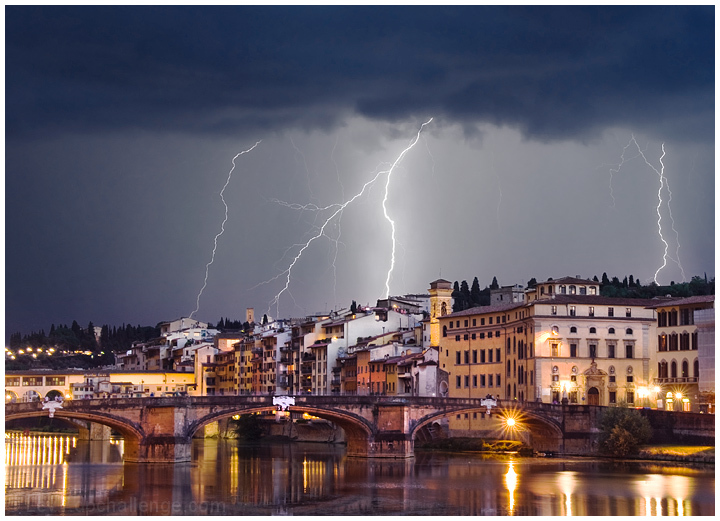
 Storm over Florence
 Add photograph to your favorites
 Add photographer to your favorites

 Photographer found comment helpful.


