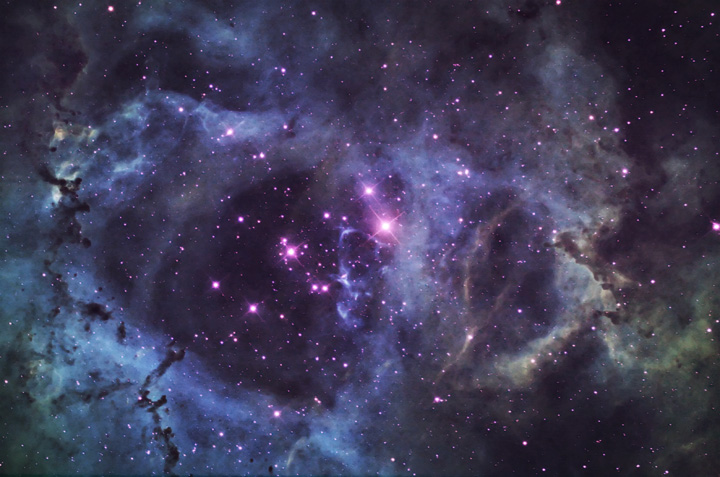
Here's my first attempt at a different type of astrophotography with my new scope called "False color imaging". In this technique, you use filtration to isolate the individual gasses that make up a nebula and assign those three filtered images to R, G and B. The mapping I used is Hydrogen alpha to Green, doubly ionized oxygen to blue and ionized sulfur to red. The Hubble telescope also uses this palette, thus it's referred to as "the Hubble Palette". I don't have high hopes for this image since it's such a different way of looking at deep space, but it does allow the viewer to distinguish parts of the nebula that otherwise are virtually identical (hydrogen alpha and ionized sulfur are both deep red). Here's a photograph I took of the rosette last year:
and here's a wide field shot of the nebula taken by pascal:
This shot is a composite of 10 seperate exposures, 4x20min sulfur filtered, 3x10min hydrogen alpha and 3x15min oxygen filtered.
Statistics
Place: 31 out of 436 Avg (all users): 6.4122 Avg (commenters): 7.8571 Avg (participants): 6.3366 Avg (non-participants): 6.5745 Views since voting: 1523 Views during voting: 268 Votes: 148 Comments: 10 Favorites: 3 (view)
I could simply say congratulations for this image, but it wouldn't be enough. It seems almost unbelievable to achieve such a detailed narrowband image using a DSLR instead of a dedicated astronomical monochrome CCD.
I am curious on how you have placed the Ha, OIII and SII filters as there is only one filter wheel that can be attached to a DSLR (as far as I know) with only 2 positions. The other way is to take the specific set of frames replacing each filter, but then you may loose a significant amount of the original frame's FOV, besause of the difference in orientation.
Finally, I think that astronomical images like this belong to a different class and can not compare directly to any other kind of image here on DPC. So, keep up the good work John!





 Add photograph to your favorites
 Add photographer to your favorites


 Photographer found comment helpful.


