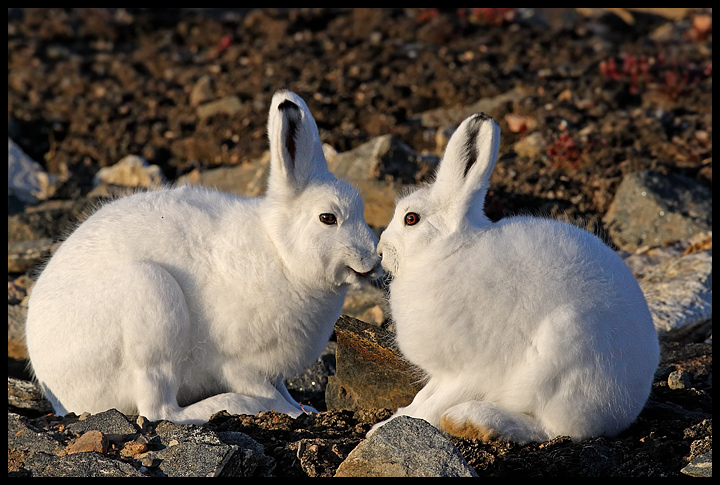
It is almost hard to believe that it has been over a year since the last double take challenge. I entered that challenge with a photo that I know I shouldn't have. The problem was I didn't have a shot to enter and needed to enter for the DPL so I threw the photo in with a title that I was hoping to get some laughs out of. The photo bombed, landing me in third to last place I think. So this photo is about redemption. I was out on the hills around Thule and came across a pack of five Arctic Hares. I managed to snatcht his photo of two of them almost nose to nose. I bumped the aperture up to f11 hoping to get them both in focus, but the hare in back is slightly OOF. I tried sharpening it independently to help it out and I am hoping the smaller size of the photo will help to hide that a bit.
The Arctic Hare (Lepus arcticus) is a hare which is largely adapted to polar and mountainous habitats. It was once considered a subspecies of the Mountain Hare, but it is now regarded as a separate species. It is distributed over the tundra regions of Greenland and the northernmost parts of Canada as well as Alaska. In the far north, it is white year-round; in other parts, it is a frosty blue grey color in summer but the tail remains white. It is an average of 22-28 inches long, it weighs about 9-12 lb. The Arctic Hare mainly eats woody plants. It eats buds, berries, leaves and grass. It has a keen sense of smell and may dig for willow twigs under the snow.
Statistics
Place: 47 out of 150 Avg (all users): 5.9343 Avg (commenters): 7.0000 Avg (participants): 5.8200 Avg (non-participants): 6.0000 Views since voting: 1696 Views during voting: 213 Votes: 137 Comments: 7 Favorites: 2 (view)







 Add photograph to your favorites
 Add photographer to your favorites


 Photographer found comment helpful.


