Challenge: Free Study 2008-08 (Advanced Editing VII)
Camera: Canon EOS-40D
Lens: Canon EF 100-400mm f/4.5-5.6 L IS
Location: Thule Air Base, Greenland
Date: Aug 18, 2008
Aperture: f8
ISO: 400
Shutter: 1/50
Galleries: Nature, Animals
Date Uploaded: Aug 31, 2008
|
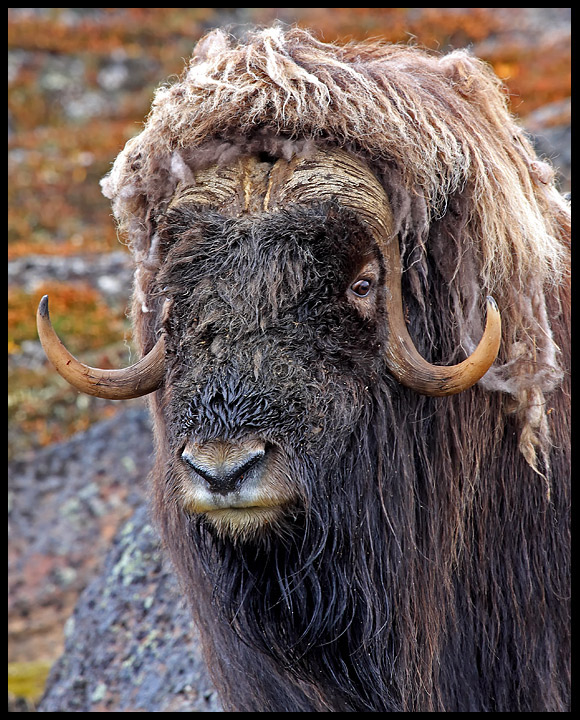
Spotted outside of Dundas Village near Thule Air Base, Greenland, this Muskox was a treat to photograph.
The muskox (Ovibos moschatus) is an arctic mammal of the Bovidae family, noted for its thick coat and for the strong odor emitted by males, from which its name derives. This musky odor is used to attract females during mating season.
Muskoxen are more closely related to sheep and goats than to oxen, but are in their own genus, Ovibos. Both sexes have long curved horns. Muskoxen are usually around 2.5 m (8.2 ft) long and 1.4 m (4.6 ft) high at the shoulder. Adults usually weigh at least 200 kg (440 lb) and can exceed 400 kg (880 lb). Their coat, a mix of black, gray, and brown, includes long guard hairs that reach almost to the ground.
Muskoxen are social and live in herds, usually of around 10–20 animals, but sometimes over 70. Winter herds consist of adults of both sexes as well as young animals. During the mating season, which peaks in mid-August, males compete for dominance, and one dominant bull drives other adult males out of the group. Non-breeding males will often form male only herds of 3-10 or wander the tundra alone. During this period all males are extremely aggressive. Bulls will even charge birds if they are close by.
A molting muskox Female is sexually mature at two years of age, and males reach sexual maturity after five years. The gestation period is eight or nine months. Almost all pregnancies yield single calves. The young nurse for a year, but may start to eat grasses as soon as a week after birth.
Muskoxen have a distinctive defensive behavior: when the herd is threatened, the bulls and cows will face outward to form a stationary ring around the calves. This is an effective defense against predators such as wolves, but makes them an easy target for human hunters.
The muskox, or its ancestor, is believed to have migrated to North America between 200,000 and 90,000 years ago. It is agreed however that the muskox was alive in the Pleistocene period making it a contemporary of the Mammoth. It is thought that the muskox was able to survive the last ice age (Wisconsin glaciation) by finding ice free areas away from prehistoric peoples. The muskox gradually moved across North America and arrived in Greenland during the late Holocene. |







 Add photograph to your favorites
 Add photographer to your favorites


 Photographer found comment helpful.


