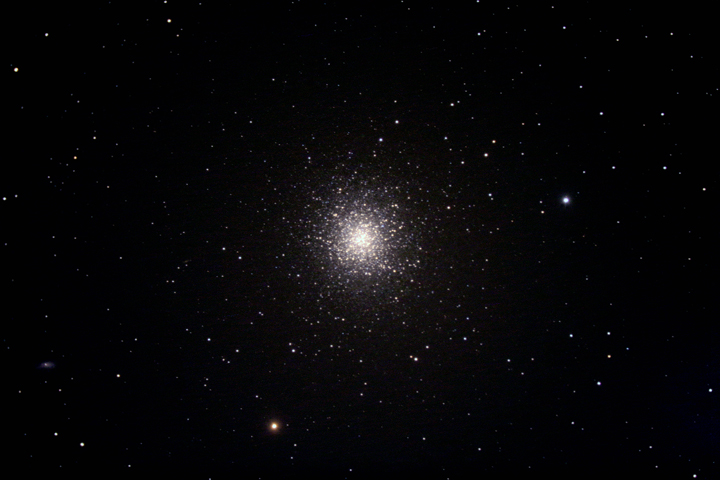
Located 25000 light years away the great globular cluster M13 in Hercules is one of the showpieces this season every year at the Northern celestial hemisphere.
M13 is one of the dozens of globular clusters that are scatterd in a halo around Milky Way, our galaxy. Its view is spectacular through an 8 inch (tube diameter) telescope, though it can be easily observed even with binoculars.
Its angular diameter of 20' corresponds to a linear 145 light years across, while visually it is perhaps 13' large. It contains more than 300,000 stars. Towards its center stars are about 500 times more concentrated than in our solar neighbourhood. The estimated age of M13 is between 11 and 12 billion years.
Nearby, about 40 arc minutes north-east of M13, is the faint galaxy NGC 6207, visible here at the left-down corner.
10 exposures were combined in order to get this final image, more specifically:
120 sec in ISO 800
120 sec in ISO 400
82 sec in ISO 1600
7 x 60 sec in ISO 1600
All the exposures were unguided; the Takahashi EM200 mount after a careful balance of the counterweights and precise polar alignment was absolutely perfect.
Equipment that was used:
Image scope : Celestron C8 SCT with focal reducer at f/6.3
Mount : Takahashi EM200 Temma II Jr
Statistics
Place: 15 out of 46 Avg (all users): 6.3452 Avg (commenters): 6.8750 Avg (participants): 6.3793 Avg (non-participants): 6.3425 Views since voting: 1608 Views during voting: 754 Votes: 394 Comments: 27 Favorites: 1 (view)
I may be wrong but I think that if you're talking "universe" and not just our "clumped galaxy" I think that a random line is more likely to never "hit" a star.
Although there are more stars in the universe than grains of sand on the Earth, there is MUCH more empty space !
If you remember the scientist that said different please let me know. I'd like to read what he has to say.
Originally posted by Zoomdak:
Truly amazing how many stars are in the sky. There is a statement by some astronomer at some time that if you point any direction to the night sky, if you follow a direct line from that you will eventually reach a star (even in we can't see it from earth). For the universe is so expansive, that there is an infinite possibility of that line hitting a star.
I like this, especially that you've captured this cluster so well, but I'd rather have the focal point off center.
Somebody's got a very nice 10" telescope! M13 I'm guessing. I doubt this will be appreciated by the dpc crowd for this amazing resolution, but I appreciate it, very very well done.
The centering of the subject really doesn't work for me here. It doesn't need that position to draw interest and it removes focus from any other less bright, but interesting, patterns in the sky.




 Add photograph to your favorites
 Add photographer to your favorites


 Photographer found comment helpful.


