My second attempt at photographing snowflakes. A slightly different technique than the first time (where I used extension tubes on my macro lens and black velvet). Here, I used the same, older non-USM Canon 100mm/2.8 Macro but with a reversed Canon 50mm/1.4 hanging off the end on a macro coupling ring and a piece of glass.
I "caught" these snowflakes by putting the piece of glass outside while it was flurrying (which only happened once during the challenge week, so the brief snow -- it only lasted about 20 minutes -- was my only opportunity.)
The temperature was close to freezing, so the snowflakes were melting pretty quickly once they hit the glass. I would stare at the glass looking for individual snowflakes as they landed. Once I found one I liked, I would move under our covered porch to prevent more snowflakes from accumulating.
This one caught my eye because it was 12-pointed; but it was "conjoined" to a 6-pointed flake. I didn't have time to switch the orientation of my camera (mounted on a tripod and pointing straight down) to portrait, which is why the top of the 6-pointed snowflake got cut off.
The background was achieved by elevating the glass on an old stool, hanging the part of the glass with the snowflake over the edge, and putting some metallic-looking multi-colored fabric on the ground underneath the glass. Because the fabric is way beyond the focal plane, it blurs nicely.
Naturally lit by the overcast sky.
Post-processing: Cropped from landscape to portait; some dust specs cloned out; coloring tweaked.
Statistics
Place: 1 out of 165 Avg (all users): 7.3852 Avg (commenters): 8.6154 Avg (participants): 7.2688 Avg (non-participants): 7.6429 Views since voting: 15528 Votes: 135 Comments: 64 Favorites: 111 (view)
Uhm. I hadn't seen this before. This is one of the best pictures I think I have ever seen. I actually like the fact that the other flake has been cut off a bit. It is ok. It keep the focus on the main attraction, but it's cool that it's conjoined.
This is awesome - great job. I spent most of last week looking at flakes landing on my gloves thinking about taking a picture - but this is just brilliant - love it.
I tried and tried to get a similar shot, but just couldn't do it. I'm really impressed that you not only got these snowflakes, Eddy, but that they are so beautiful and so clear. Congratulations on this well deserved ribbon!
For those who are going to try photographing snowflakes yourself, here are a couple more tips:
1) Keep your glass, fabric, etc. outside. If you have to wait for your "snow catching device" to get to the same temperature as the ambient air, you may lose a good opportunity as the snow will melt instantly if the items are warm.
2) Keep a spare battery in your pants pocket (not your coat pocket). Batteries perform worse in cold weather. Keeping a spare in your pocket will allow you to swap it quickly if necessary, and since your body heat will keep it warm, it should perform much better.
3) Realize that not all snow is good "photography" snow. Sometimes the snow is just "frozen balls of ice" (technically sleet) without any detail, and sometimes the ambient temperature is just too warm for the flakes to last. Snowflakes form when water vapor condenses directly into ice up in the clouds. The beautiful patterns form as the crystal grows. Colder temperatures make snowflakes easier to handle and last longer.
4) Don't breathe on your snowflakes! They will melt from your breath.
5) It is possible to catch snowflakes on something smooth, such as dark-colored foamcore (which makes it easy to see the flakes), and then carefully use a toothpick to move a particular flake to your glass or fabric or whatever.
6) Snowflakes are tiny! You could easily fit 10 or 15 typical snowflakes on a penny! The flakes get bigger as the temperature drops further below freezing, and then they start to get smaller again as the temperature gets even colder.
6) Lighting is the key! Since "clean snow" is nothing more than an ice crystal, it can be as clear as glass.
7) 12-sided snowflakes aren't rare, but they aren't nearly as common as 6-sided snowflakes. You'll never find 4, 5 or 8-sided snowflakes, but you'll occasionally see triangular-shaped 3-sided snowflakes. The uncropped version of my photo also has a 3-sided snowflake in the frame (and no, I did not manipulate the position of the snowflakes at all. It just happened that way!)
This is a really terrific shot - I can't wait for it to snow so that I can try something along these lines (I have a new macro lens I am dying to make use of). The background is terrific.
This is incredible!! I'm amazed it's a real snowflake! Here in AZ we make those out of paper... I had no idea they were really shaped like that... lol. Truly brilliant work Eddy, congrats on the blue. :-)
If these are real flakes, I'd love to hear how you captured them without melting and so perfectly squarely. If they aren't real, you stil have a beautiful picture here.
The subject is stunning, beautiful lighting and crystal clear focus (pun intended). I can't imagine anyone voting less than 10 really - apart from being a bit pedantic about your cropping. Personally I just love to see these wonderful things in such detail. [10]
Very very cool shot. (No pun intended!) Details, I want details! Hope you have some in your photog comments section. ! Would have been absolutely perfect with a third, or even part of a third, snowflake, making for a more dynamic composition.
Neat shot (what is it a picture of?). Love the the color and composition, although I think 'landscape' orientation performs better in these challenges.






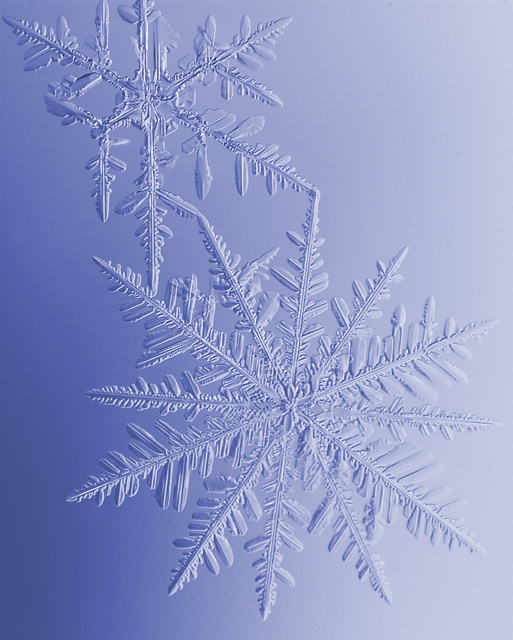
 Synergistic Snowflakes
 Add photograph to your favorites
 Add photographer to your favorites

 Photographer found comment helpful.


