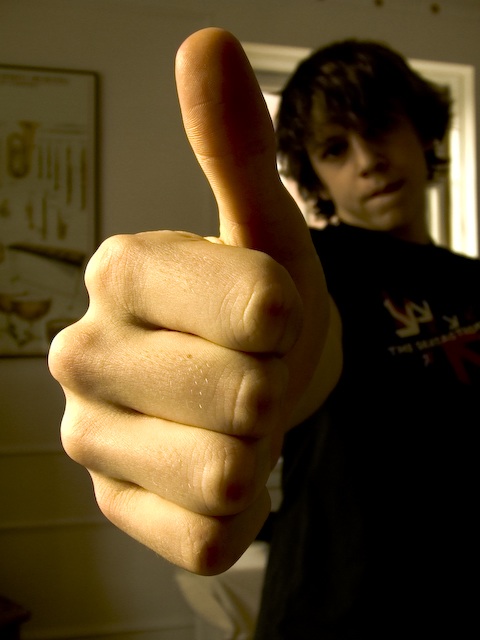
Taken in Raw, and in summary of a pretty large amount of edits, converted to tif, warmed up, contrast/black clipping pump up. Self portrait so it took a while to get this way.
Statistics
Place: 97 out of 195 Avg (all users): 5.3422 Avg (commenters): 6.4000 Avg (participants): 5.1452 Avg (non-participants): 5.4172 Views since voting: 786 Views during voting: 317 Votes: 225 Comments: 10 Favorites: 0
As your other commentors have mentioned, your hand is in good focus, well lit and overall you've done a good job of showing us your hand. The next question is, why do we want to look at your hand? This is a variation on the question we ask of any photograph: why do we want to look at this photo? So let's look at some reasons:
1. Meeting the challenge. The hand is in a symbolic thumbs-up gesture, thus meeting the challenge. This plus the "good technicals" on the hand gave you a 5+ score. Meeting the challenge will not guarantee you a good score, however. Viewers are still looking for a good photograph, probably one that would be worth looking at even without the challenge (though there are exceptions).
2. Interaction with the background. As with so many photos, you have a foreground subject with a background behind it. One interesting thing here is that the person in the background is the same person whose hand we're looking at. Even more interesting, it's the face that is blurry background material. We're used to faces being the subject. One trouble I might have is that this is not a very original idea. rscorp has done it several times, but not everyone is concerned about originality. But, as other commentors have noticed, you have other items in the background as well, and they are a bit distracting. The usual solution offered by DPC is to remove the background, or at least make it as blank as possible. I'm not crazy about this approach. I think it's usually a cop out, unless you're making catalog photos or stock photos. Much more interesting and challenging is to have a background that enhances your image instead of distracts from it. For example, I don't mind seeing a door. It's a little glimpse of setting, so I can start thinking about the character of this person, where he lives, what his life is like. If, for example, you replaced that poster with an eye chart, I might think you're an eye doctor. Well, you're kind of young to be a doctor. Maybe a patient? Maybe an eyeglass salesman? The single most important thing I've learned from taking pictures is to be aware of the background. I am still no good at getting the right background for the right subject. I think it's a lifetime process.
3. Symbolic value. This is a strongly symbolic image. Most if not all images, however, have some sort of symbolic value. A symbol itself doesn't have much impact. A thumbs-up by itself doesn't have much impact. However, if it is the surgeon who was operating on Mom, then his thumbs-up suddenly has a LOT of impact. Your job as a photographer of a symbol is to connect the general symbol to some kind of specific meaning. I gave an example above of how you can do that with the background. You can also fight the meaning of the symbol. For example, you could have someone crying while holding his thumb up. That would probably be a bad idea for this particular challenge, but it would make for a more interesting photo in general.
I think this picture is over all well done. I like that there is person half faded and blurred in the background. The picture would be pointless with just a hand with a thumbs up. It would be better without the picture and door in the back and the Color balance is a little off.... but I like it. It actually (with the title and picture put together) made me laugh. Can't wait to see more work!
I like the idea here. Perhaps if it was just the hand it would be a bit stronger. You also don't have to tell us that thumbs up is good. I think we might already know that. Helping the viewer out with the title is one thing but you don't have to thump them over the head with it.
That aside I like the detail shown in the hand. The person is really just a distraction. When you are composing, decide what you want to be the subject and then decide what elements to add to that. (I should maybe try that out myself now that I think of it.)






 Add photograph to your favorites
 Add photographer to your favorites


 Photographer found comment helpful.


