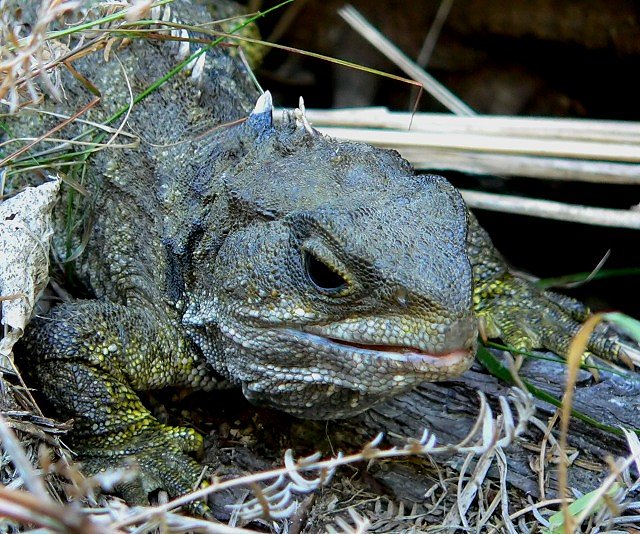
The Tuatara is a lizard like creature that is only found on certain small islands around New Zealand. It is not a true Lizard but a "Living Fossil", a survivor of a group of animals that were once more widespread. They look very much like lizards but their skeleton shows many differences.
They are the only extant members of the Order Sphenodontia, which was well represented by many species during the age of the dinosaurs, some 200 million years ago. All species apart from the tuatara declined and eventually became extinct about 60 million years ago. Only Tuatara survived to become a "living fossil".
Tuataras survived because no predators invaded New Zealand. Terrestrial mammals failed to cross the Tasman Ocean, which separated New Zealand from Australia by opening about 90 million years ago. Tuataras are unusual reptiles, since they like cool weather. They do not survive well over 25 degrees centigrade but can live below 5 degrees, by hibernating in burrows. New Zealand climate was just right.
Then humans arrived and introduced kiore, dogs, ferrets, pigs and cats...
Tuatara once lived throughout the mainland of New Zealand but have survived in the wild only on 32 offshore islands. These islands are characteristically free of rodents and other introduced mammalian predators which are known to prey on eggs and young as well as compete for invertebrate food. The islands are usually occupied by colonies of breeding seabirds that contribute to the fertility and hence the richness of invertebrate and lizard fauna needed by tuatara
The ancient and rare tuatara returned to its natural environment on mainland New Zealand for the first time in over 200 years, when 70 tuatara were released at Karori Wildlife Sanctuary on Thursday 8 December.
The tuatara are now living freely in a newly constructed research area within the Sanctuary. Already the tuatara are a big hit with visitors with many being seen in their new home – both during the day and on night tours.
Tuatara became extinct on New Zealand’s mainland due to predation and have only survived in the wild on several rat-free offshore islands. They are now able to be returned to the mainland at Karori Wildlife Sanctuary due to the ground-breaking success of our unique fence which has excluded mammals that would otherwise prey on tuatara. (www.sanctuary.org.nz)
I love the look of this beasty and did the following:
Cropped
Brightness and contrast
neatimage
cloned out the identification beads
reduced
saved jpeg
sharpened
saved
loaded
...
tried to think of a name.
Statistics
Place: 102 out of 261 Avg (all users): 5.6794 Avg (commenters): 7.7778 Avg (participants): 5.6000 Avg (non-participants): 5.7174 Views since voting: 3538 Views during voting: 414 Votes: 340 Comments: 10 Favorites: 0
Nice job here. You have good definition, good color and a nice composition. And, while not a great score, certainly a decent one.
IN this crowd on nature photography, that's hard to do. I have just one suggestion for you in this very nice image: because this was an advanced editing Challenge, you might want to consider either blurring out or otherwise obscuring those reeds to the right of the critter's head. They are the brightest part of the image, and the viewer will look at them first instead of the guy's form and face.
Of course it doesn't help his cause that he lives in a mess, but you probably couldn't exaactly reach in and pose him. ;>)
All in all, a nice image that scored pretty well.
It looks as if you are enjoying your DPC experience and I look forward to seeing more of your work.
Ol'grumpy face by the looks of things. Good detail and colour. If you have these things running around near you you're lucky as they are a very endangered species.





 Add photograph to your favorites
 Add photographer to your favorites

 Photographer found comment helpful.


