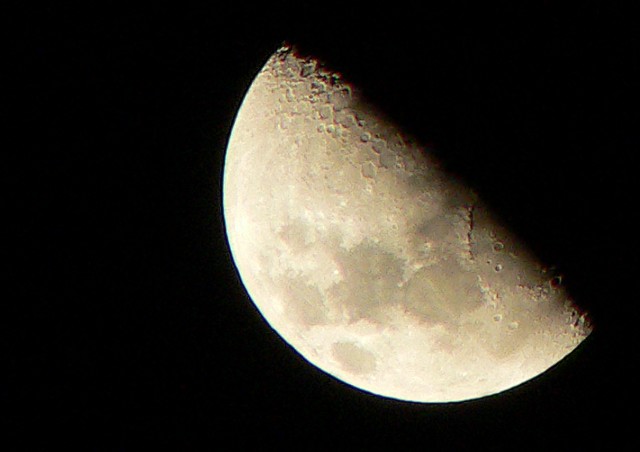
Just fooling around outside on a stunningly clear night when I decided to see what I could get out of my 650mm lens. T be frank, I wasn't expecting that much.
There is a formula for how big a moon image you get for each lens but the only part I can remember is that you divide a whole bunch of lens numbers by 110. I think it all means that you get an 18mm image with a 1000mm lens.
When I got this image to the computer I was speachless when I blew it up to see the detail of the craters and mountain ranges on the moons surface in the low asimith light.
This crop is only 26% (711x502) of the original image's 2560x1920 pixels so the enlargement is fairly extreme yet the detail still holds. I'm stunned.
Incidentally, I've tried other phases of the moon since but it is this first one with the light hitting the moon's equator that shows the most relief detail.
Statistics
Place: 93 out of 274 Avg (all users): 5.3202 Avg (commenters): 7.8889 Avg (participants): 4.9855 Avg (non-participants): 5.4925 Views since voting: 2534 Views during voting: 299 Votes: 203 Comments: 11 Favorites: 1 (view)
Very nice picture. Like the position of the moon, gives it a sense that it is moving into the photo. Love how clear the craters are defined, this is one shot that still eludes me. Good job!







 Add photograph to your favorites
 Add photographer to your favorites


 Photographer found comment helpful.


