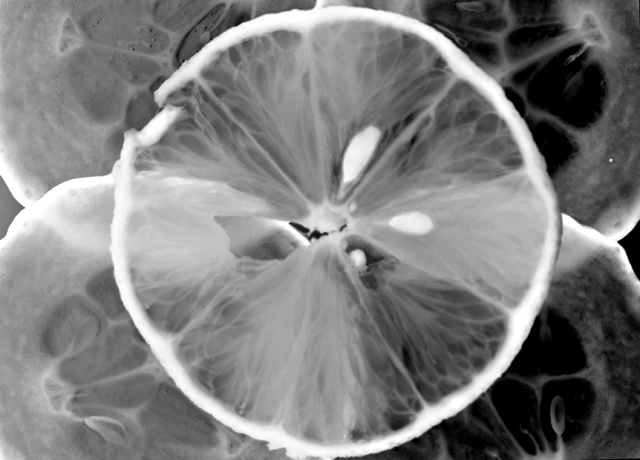
I've always been fascinated by the work of the early photographic artists and especially Man Ray. He pioneered the technique of producing "photograms". The technique involved arranging elements of the image on photosensitive paper, exposing to light and development of an image. The degree of exposure of any point on the image is dependant on overall exposure time / light levels, and the transparency of the object. These lovely images were known as Rayograms. I've never seen a Digital Rayogram so I thought that I'd have a go.
The "paper" is a glass screen with a diffuser in a light tight "dark box" lit through an orifice from the underside. The Camera was fixed to a gaiter seal directly above the screen. This puts the CCD/camera in the position of the photosensitive paper looking "up" at the underside of the image.
The important aspect of the technique is to prevent any tramp light from within the "dark box" reflecting from the "underside" of the subject and registering as surface detail. This was done by masking the subject, stuffing the box with light absorbing materials and trial and error with light intensity.
Photograms capture light passing through the subject not reflecting from it. They capture form and structure rather than texture and colour.
Traditional photograms were limited to monochrome media and obviously register as a reversed exposure. To be faithful to the technique, my submission is rendered in that format. However, with modern image manipulation, there's virtually no limit to the artistic potential of the photogram.
Post processing was adjustments in contrast with some USM, slight rotation, levels and curves.
If this type of image is not widely known, I expect to score badly with this one but as the challenge calls for innovative technique and I've never seen a digital Rayogram, I'm happy with my attempt.
Statistics
Place: 36 out of 191 Avg (all users): 5.7976 Avg (commenters): 5.8571 Avg (participants): 5.4615 Avg (non-participants): 5.9224 Views since voting: 5129 Views during voting: 502 Votes: 336 Comments: 9 Favorites: 3 (view)





 Add photograph to your favorites
 Add photographer to your favorites

 Photographer found comment helpful.


