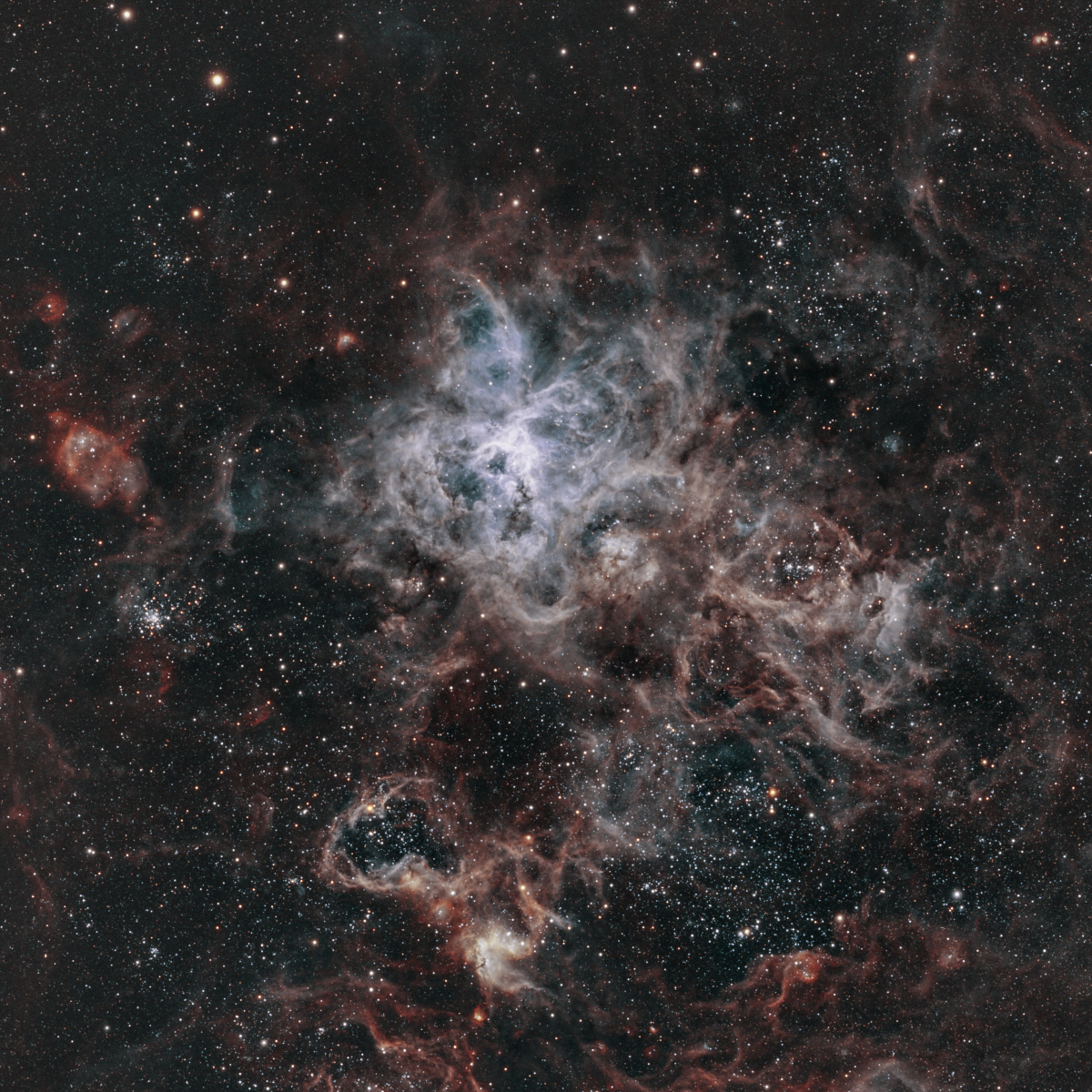
Had a clear night on the 10th. I think this was with an Oiii filter. Actually meant to take Ha.
Taken with Svbony SV503 102ED and SV605MC.
Disqualification Details
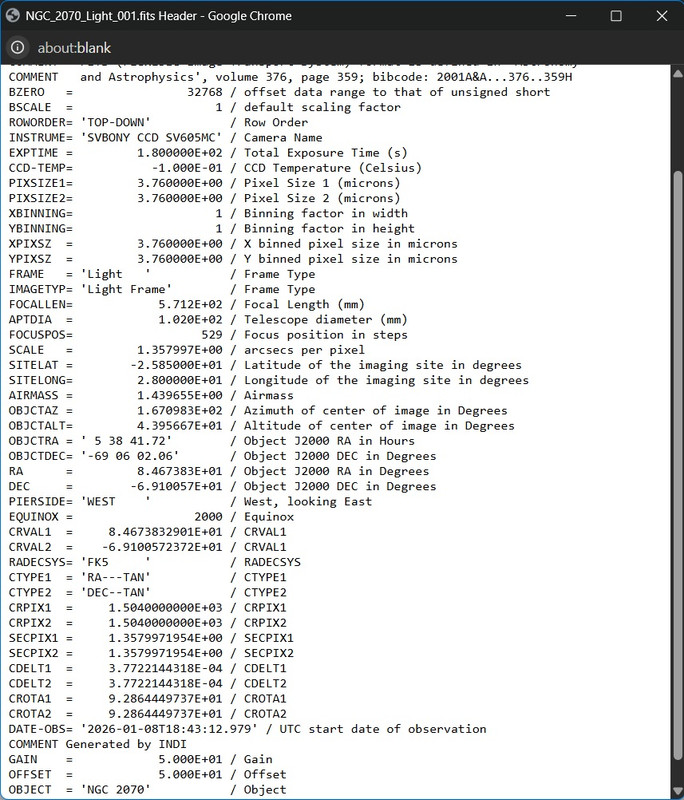
We review each original file submitted for validation to confirm that it has not been modified and that it was captured within the challenge date window. This verification relies on standard EXIF metadata that our tools can interpret consistently.
In this case, the image was captured using a telescope and the available metadata does not allow us to reliably confirm those requirements using our current process. To ensure the same standards are applied uniformly to all entries, we are unfortunately unable to validate this submission and must disqualify it.
Statistics
Views since voting: 378 Views during voting: 60 Comments: 15 Favorites: 0
Unfortunate that that this was disqualified... I congratulated the current blue winner and also sad that he has limited front page exposure. Without discounting others, your image stands out.
I am still confused why this was disqualified.. I looked up on the filetype .fits and it says: "a .fits (Flexible Image Transport System) file is a type of raw data file, often considered a "Super RAW" in astrophotography, as it stores the direct, unprocessed data from a camera sensor. Unlike standard image files, FITS files contain high bit-depth (8 to 64-bit) data and detailed metadata (camera temperature, exposure, etc.), requiring specialized, non-standard imaging software to open and process.
Could someone please clarify what the disqualification was based on..was it because the file was .FITS (not an accepted RAW format for this competition), or specifically because of concerns about editability/processing?
Unfortunate that that this was disqualified... I congratulated the current blue winner and also sad that he has limited front page exposure. Without discounting others, your image stands out.
I am still confused why this was disqualified.. I looked up on the filetype .fits and it says: "a .fits (Flexible Image Transport System) file is a type of raw data file, often considered a "Super RAW" in astrophotography, as it stores the direct, unprocessed data from a camera sensor. Unlike standard image files, FITS files contain high bit-depth (8 to 64-bit) data and detailed metadata (camera temperature, exposure, etc.), requiring specialized, non-standard imaging software to open and process.
Could someone please clarify what the disqualification was based on..was it because the file was .FITS (not an accepted RAW format for this competition), or specifically because of concerns about editability/processing?
I will search for which raw formats are allowed, as those captured with my digital camera are clearly not. But the meta data is available. I also want the record to show who would not have won blue had this technicality not been an issue.
I understand and support the SC's decision. But I wanted to add a personal note of congratulations for a stellar image. Pun intended. This is first-rate astrophotography, and as one who is more often than not bored by such images (I know, I know...), I hope that registers as a huge compliment. :-D
For the colour I did more or less half the time with each filter, but in sequences of 3-minute exposures. Oiii is a teal colour and H-alpha is quite a deep red. The images are stacked to reduce noise and increase signal, and the final image can then be stretched with the histogram to bring out the detail.
To combine the two stacks, I use the following equations:
Red = Ha
Green = ((Oiii*Ha)^~(Oiii*Ha))*Ha + ~((Oiii*Ha)^~(Oiii*Ha))*Oiii
Blue = Oiii
Using filters helps to cut through the light pollution. I prefer a mono camera as well - for colour cameras there are filters which combine the different wavelengths, but you only get a portion of each pixel per colour. With mono you have the entire pixel to capture photons for a particular filter.
Stellar image Marc (in both senses)! Congrats on your blue ribbon! I am how you created the color image with your monochrome camera: did you make a 2.5 hours exposure with one filter and then 2.5 hours with another?
Wow, what a great surprise. I'm so glad my image was well received.
This is NGC 2070, the Tarantula nebula in the LMC, so a truly remarkable thing. It's said that if it were as near to us as the Orion nebula, it would cast a shadow.
In my original comment I had only gotten Oiii data, but we had unexpected clear gaps so I added Ha, but didn't edit my comment.
This was taken with an Svbony SV605MC (Sony IMX533 mono), which is a square crop sensor. The telescope is an Svbony SV503 102mm with the 0.8x focal reducer, at 571.2mm. The filters were 7nm H-alpha and 7nm Oiii. The total imaging time was around 5 hours, but I'm not exactly sure how much I used in integration, but it wasn't much less than 5 hours.





 Add photograph to your favorites
 Add photographer to your favorites