i personally feel robber flies are the most handsome .. interesting and photogenic of all the insects ..
although the long legged flies are pretty awesome too and i feel would go better in a dpc challenge ...
there were lots of long legged flies around for a while a couple of months back .. unfortunately now they are nowhere to be seen ..
its interesting how the insect life changes with the seasons and with the years ... some insects that i used to see a lot a few years back were the paper wasps .. now i dont see them at all ..
anyway .. hopefully ppl will enjoy seeing all the incredible details of this robber fly .. :)
here's some interesting info ..
The Asilidae are the robber fly family, also called assassin flies.
"The world is full of robber flies — approximately 7,000 species have been recognized worldwide and 1,000 are native to North America. All robber flies are predators on insects and have two wings, prominent spikes on their legs, stout hairs on the body, a prominent proboscis fashioned into a sharp tube or beak and large, widely-spaced compound eyes. The mystax, composed of stout and stiff facial hair resembling either a beard or mustache, protects the robber’s face and eyes from a flailing, impaled prey. Robbers have three simple eyes in a pit between the compound eyes, near the top of the head.
Robber flies usually take prey smaller than themselves, but they have been reported to take dragonflies, bees, wasps and butterflies that are larger."
Robber’s modified mouthparts form a stiff, hollow beak that serves first as a dagger, then as a hypodermic needle and finally as a straw. When robbers impale prey they inject both neurotoxins and digestive enzymes. The neurotoxins quickly subdue and soon kill the prey. The digestive enzymes turn the prey’s internal tissues to soup, but do not damage the tough chitinous exoskeleton, which now serves as a watertight container full of thick broth. Fluids are sucked through the beak until the carcass until is a dry husk.
Robber flies are flexible hunters. Most hunt by intercepting flying insects from one of several perches in their territory. Others snag prey from vegetation or pounce on prey on the ground. They usually return to a perch in their territory to consume the prey, which takes from 5 to 15 minutes for small prey but perhaps more than an hour for large prey."
after rollover ..
was incredibly surprised this did so well .. was a really exciting week ..
thanks everyone for your votes and comments .. xx ..
Statistics
Place: 1 out of 49 Avg (all users): 7.6250 Avg (participants): 7.3750 Avg (non-participants): 8.0000 Views since voting: 1412 Views during voting: 86 Votes: 40 Comments: 15 Favorites: 0






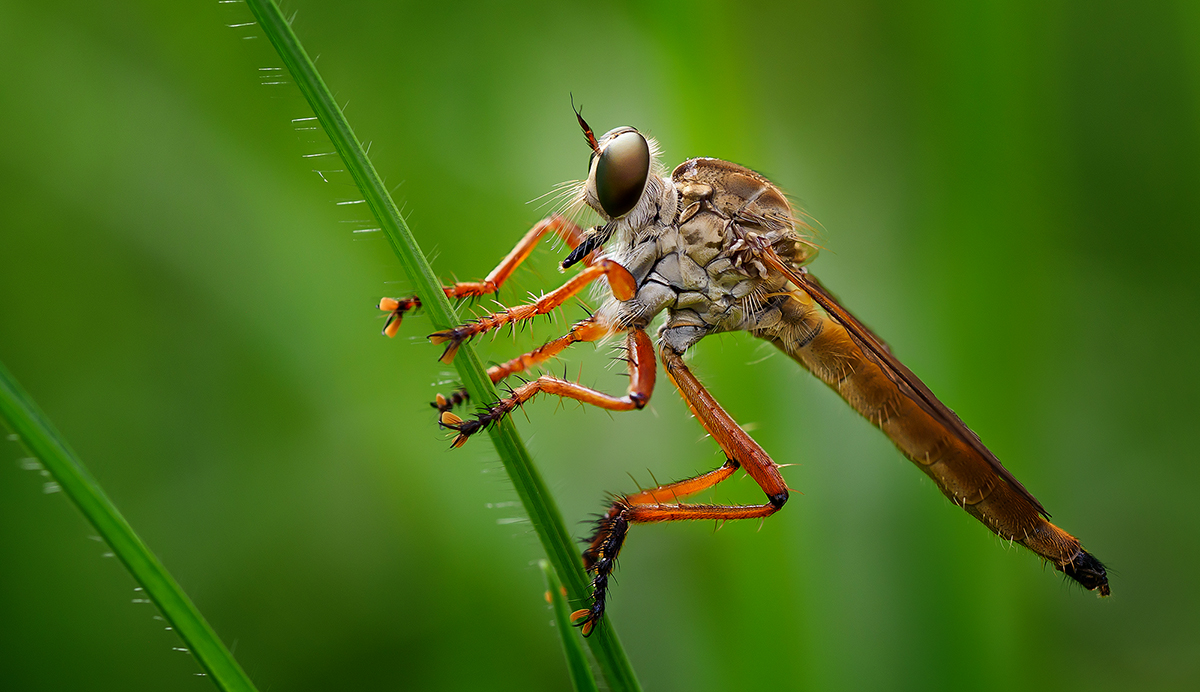
 Robber Fly in the grass
 Add photograph to your favorites
 Add photographer to your favorites

 Photographer found comment helpful.


