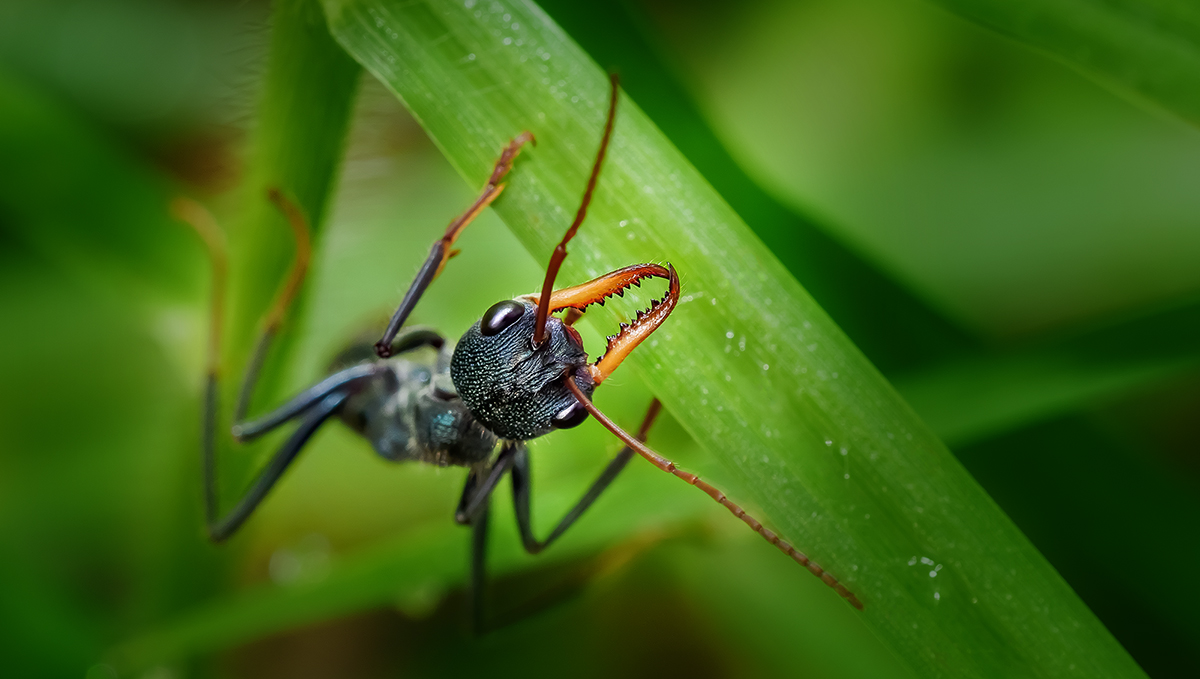
i was looking for something to photograph near the house .. there was nothing as it was quite cold .. then i spotted this bull ant moving around in the grass .. when he saw me he raised himself up in a threatening manner ... then went back to wandering around but also trying to hide from me behind blades of grass ... the end of my lens would be about 6" to 8" from him ..
bull ants don't bite with those fearsome looking mandibles .. they use them to move eggs .. carry food .. and build their nests ..
they do sting with their rear end tho .. and its very painful .. i got bitten once .. so i know ..
below is some info i got online ..
Bull ants have a fearsome reputation, and deservedly so Identification Size Range 8 mm - 40 mm. Bull ants are large, alert ants that can grow up to 40 mm. They have characteristic large eyes and long, slender mandibles and a potent venom-loaded sting. They have superior vision, able to track and even follow intruders from a distance of 1 metre. Many species of bull ants have bright red or orange colours on the head or abdomen.
There are about 90 species of bull ants in Australia with diverse behaviours and life cycles. Nine bull ant species have been recorded in Sydney, but there may be more as yet undiscovered. Some of the smaller species are known as jumper ants after their habit of aggressively jumping toward intruders.
Habitat Bull ants live in urban areas, forests and woodland, and heath.
Distribution Bull ants are found throughout Australia.
Feeding and diet Bull ants collect nectar and other plant juices, as well as animal prey, which are carried back to the nest.
Other behaviours and adaptations Bull ant nests are usually underground and often have hidden or small entrances. The nests can extend several metres below the ground. They attack intruders of any size that come too close to their nest. Bull ants also have well-developed vision and will follow or even chase an intruder a good distance from the nest. Usually the sight of large aggressive ants streaming out of the nest is enough to prompt a hasty retreat. If not, the ants deliver painful stings by gripping the intruder with their mandibles (jaws), curling their abdomen to reveal the sting and injecting the victim with venom. Often multiple stings are delivered.
Life history cycle Several species have no colony workers. Instead, a raiding queen invades the nest of another species, kills the resident queen and takes over the colony.
Danger to humans These ants can deliver painful stings and are aggressive. An ice pack or commercially available spray may be used to relieve the pain of the sting. If there is evidence of an allergic reaction, medical attention should be sought.
thankyou so much for the two comments .. i really appreciate feedback .. xx
this was 7.2258 about 8 hours ago .. then it steadily dropped .. now 6.9744 ..
i have found this a common occurrence in the last few hours of voting ...
i'm really interested to hear if this happens to other ppl near rollover ..
thankyou in advance for your response .. xx
Statistics
Place: 5 out of 55 Avg (all users): 6.9500 Avg (participants): 6.9310 Avg (non-participants): 7.0000 Views since voting: 592 Views during voting: 71 Votes: 40 Comments: 5 Favorites: 0
I knew this was yours! You make me want to get another macro lens so much. I sold it when I went mirrorless and you make me miss it! Besides the technical ability - which is phenomenal - I envision the sense of peace that comes from knowing the ‘how’: the hunt, the quietness, etc. I just love that feeling I get when I look at your images. I am one of your many 9’s . .
Yes, a plummeting last day vote score seems to be the trend. Such a disappointment to see.






 Add photograph to your favorites
 Add photographer to your favorites

 Photographer found comment helpful.


