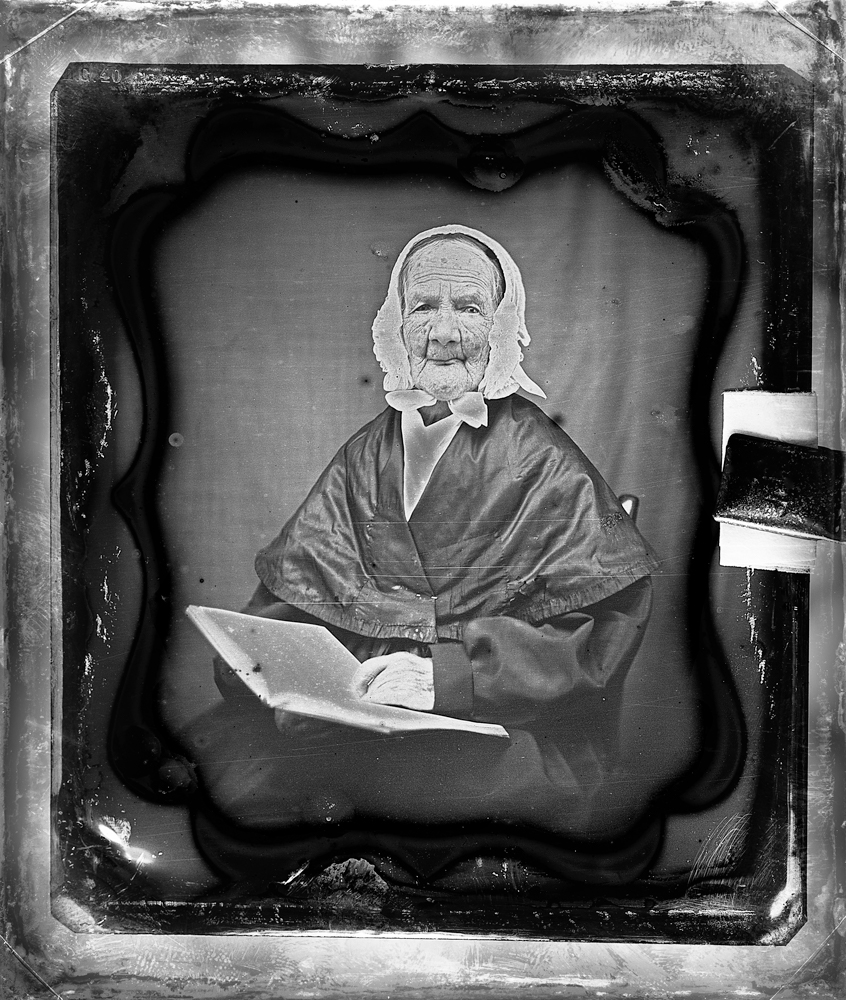
The daguerreotype process can only produce a single image, so if copies were desired, the daguerreotypist had to take another daguerreotype of the daguerreotype, often clamped in midair in front of the camera. You can usually see these clamps in the resulting copy along the edge of the plate (once cased, the image edges - and any unwanted artifacts like the clamp - would be concealed by the case's mat and preserver. Sometimes the mat used would have a much smaller than usual oval or circle cutout, so that only the face and shoulders of the copied relative were visible). The resulting image copy also would not have as much apparent sharpness and edge detail as the process could normally achieve.
This is a real daguerreotype from my collection, circa 1850. The woman pictured may have been born around the time of the Revolutionary War. The spots and scratches visible on the plate are real, although I did use Alien Skin Exposure 4 to make the rest of the image look like a daguerreotype itself.
Shot against a background that was far enough away to be mainly oof, but is wrapping paper that had been printed to resemble a 19th century wallpaper design, in case you are wondering what the patterns are surrounding the daguerreotype.
Also, the sides of the lady's white/light bonnet, the clothing area just around her neck, and the open pages of the book were overexposed by the daguerreotypist, and overexposed highlights like this become solarized, and appear as blue when viewed in person.
Statistics
Place: 13 out of 35 Avg (all users): 5.9048 Avg (participants): 5.7000 Avg (non-participants): 6.0909 Views since voting: 366 Views during voting: 100 Votes: 42 Comments: 5 Favorites: 0






 Add photograph to your favorites
 Add photographer to your favorites


 Photographer found comment helpful.


