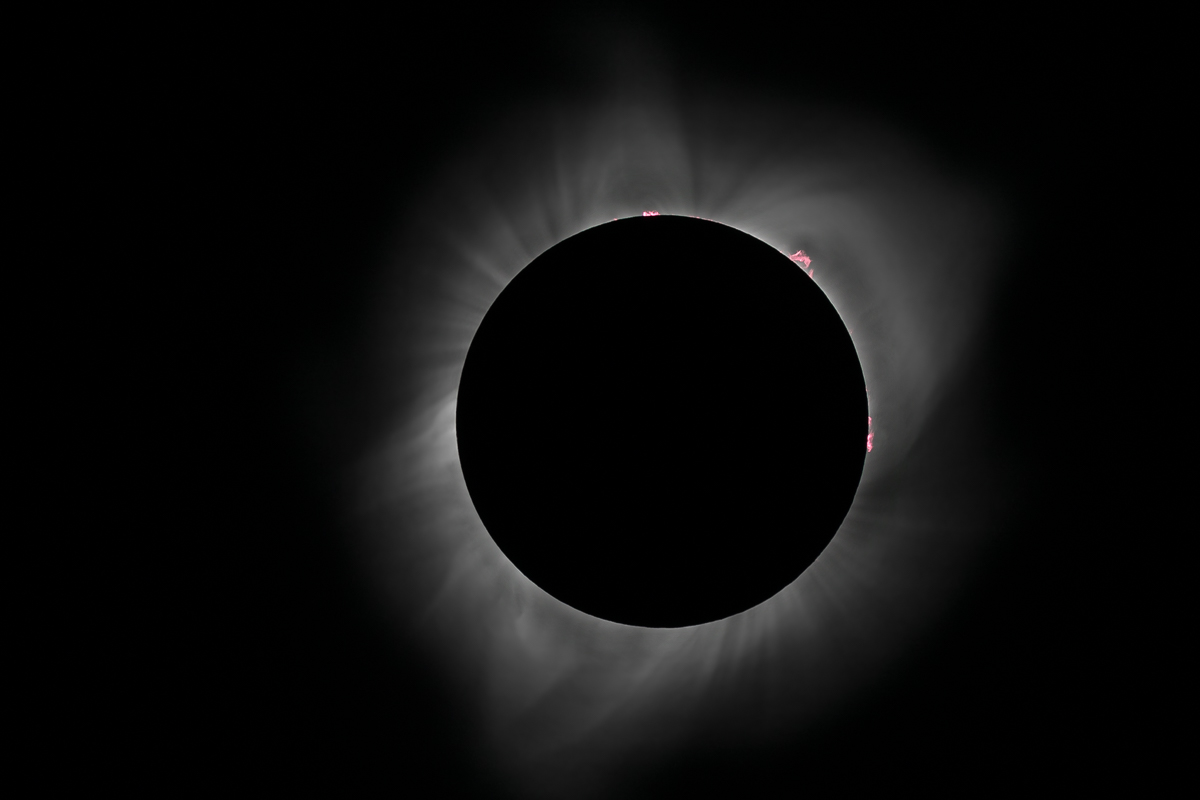
At the moment of solar eclipse totality, there was a fine line separating the observation of the prominences and seeing the detail in the sun's corona. The image below is one image... processed in Lightroom CC. The prominences appear outside the edge of the moon. A prominence is a large, bright, gaseous feature extending outward from the Sun's surface, often in a loop shape. Prominences are anchored to the Sun's surface in the photosphere, and extend outwards into the Sun's corona. Our sun is surrounded by a jacket of gases called an atmosphere. The corona is the outermost part of the sun's atmosphere. The corona is usually hidden by the bright light of the sun's surface. That makes it difficult to see. However, the corona can be seen during a total solar eclipse. This is one of the images available at Alpenglow Images & Accents.
Canon EOS 5D Mark IV, Canon EF 400mm f/4 DO IS II USM +1.4xIII, 1/500s@f/6.3, ISO 100, lens focal length 560mm.. 08/21/17 11:41am. — in Shoshoni, Wyoming.
_J3A2573-3DPC
Statistics
Place: 1 out of 44 Avg (all users): 7.0725 Avg (commenters): 8.6000 Avg (participants): 6.9091 Avg (non-participants): 7.1489 Views since voting: 2150 Views during voting: 177 Votes: 69 Comments: 16 Favorites: 1 (view)
Super capture. I'm a big sucker for astronomical photography. And this is top notch. So many features of the event are so clear here. How much time did you have to take this image? It can't have been long. How did you prepare the settings for it?
I had 2 minutes 20 seconds of totality at Shoshoni, WY. (4850' above sea level with clean, dry air really helped.) I was mounted on a tripod with shutter release cable. I didn't need a solar filter during totality. My Canon 5DMarkIV was set to take seven bracketed shots over 12 stops of light. That range and number of image captures provided just the right exposure several times. I did not have an equatorial mount, so I re-positioned and re-focused the camera for each set of images. I captured 70 images during totality plus a few seconds before (Baily's Beads) through a few seconds after (the diamond ring). I stopped down to f/6.3 to improve DOF and sharpness. My ISO was set to native 100, which gave me pretty much noise-free images. I was using evaluative metering. My focus was set to AF. I had 5 focus points activated and offset to the side slightly so I could focus on the high contrast area between the moon's edge and the sun's corona. I did look through the viewfinder to set focus on each set of bracketed images. Using "live view" was an option, but in the heat of the moment, I went with the viewfinder acquisition of focus.
The eclipse tutorials from Canon and B&H Photo were the most helpful. I thought I was prepared, but was totally shocked to be able to discern the prominences and the corona. It was an inspirational, thrilling and spiritual experience. I could not speak for an hour afterwards because I was so emotional. Now that I've seen a total solar eclipse, I long to see another. The prospect of the next in 2024 has given me incentive to try to live that long.
Super capture. I'm a big sucker for astronomical photography. And this is top notch. So many features of the event are so clear here. How much time did you have to take this image? It can't have been long. How did you prepare the settings for it?
This is great! Perfect timing and exposure. I'd think a centered square crop might improve the composition, but still my favorite, and still a capture of a lifetime!





 Prominences at Totality
 Add photograph to your favorites
 Add photographer to your favorites

 Photographer found comment helpful.


