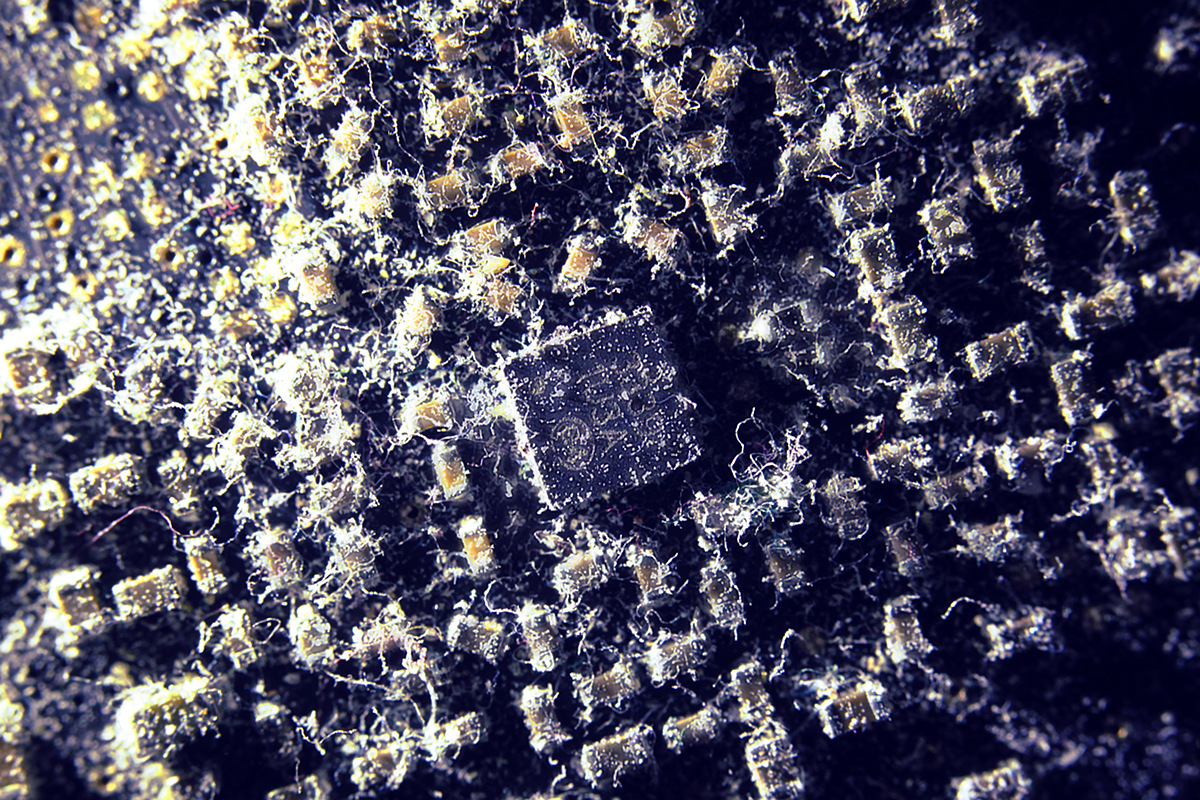
A hand-held focus stack with a home-converted true macro lens. The interior of a fairly new Macbook Pro. I'll leave commentary on the ventilation design quality of Apple products aside in this instance, and instead talk about the shot.
I mentioned that this is a photo with a home-converted lens - a bit of an experiment. An interesting trick that you can carry out with the otherwise fairly useless 35-80mm 90s plastic zoom is that by removing the front element group altogether, you can convert it to a fairly capable fixed focus macro lens. Well - although you've removed the front group which is the only part that moves to focus this lens, it's not really fixed focus, as you can still use the former zoom as a sort of magnification control. At its best, at 80mm, it provides a fairly formidable 1.7x magnification with a subject distance of around 30mm - not to be scoffed at, considering you can grab one of these otherwise crappy zooms for about £30 on ebay, and suddenly end up with a reasonable competitor to the far more expensive Canon MP-E 65mm.
At such magnifications, of course you need a lot of light and a small aperture; however, this was a snapshot taken while cleaning a business laptop, and I didn't really have time to set up the lights and a tripod - hence the fairly high ISO, as the light was an LED torch placed close to the board to project strong shadows. As mentioned earlier, this was a hand-held shot - in fact a focus stack of two images from a consecutive burst, to maximise the depth of field. I'm not entirely happy with the level of sharpness here, but I'm not sure there was much more I could do. Although I could have gone smaller than f/16, I would have started to lose more sharpness due to diffraction - and this jerry-rigged DIY lens has a rather curved field of focus anyway, so there are diminishing returns to be had in the depth of field department, anyway.
Editing: Curves to bring up the blues in the shadows and midtones and the gold in the highlights. Selective hue and saturation adjustments. Wavelet decompose, and suppression of large detail scales selectively on the surfaces of the board components. Clone of distracting details near the edges of the frame. Resize, and selective sharpen.
Statistics
Place: 50 out of 72 Avg (all users): 5.2564 Avg (commenters): 5.6667 Avg (participants): 5.1190 Avg (non-participants): 5.4167 Views since voting: 852 Views during voting: 143 Votes: 78 Comments: 19 Favorites: 0
An appealing image that fulfils the challenge brief
You do use some interesting optics Eugene, or in this case, bog standard optics made more interesting. Its an interesting concept that has come out reasonably well considering it was a quick hand-held two exposure blend. You will be the first to recognise its shortcomings but the one that spoils it most for me are the blown highlights from the harsh lighting. Having said that thanks for another interesting entry.






 Add photograph to your favorites
 Add photographer to your favorites

 Photographer found comment helpful.


