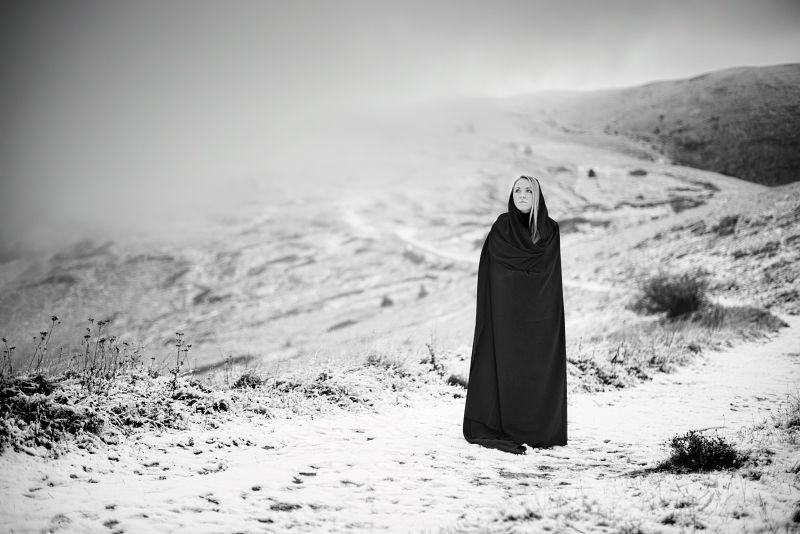
"Hyella was a land of endless winter. 101 people lived in the cold village alongside the eternal blue ice of the lagoon, and equally endless fog was a fact of life for them. Even the old Stasya couldn't remember a day of his long life when the sun had shone bright in the sky. Hyella was a world unto itself. No one walked away. Over the years some had tried, but they all had been found dead in the snow, slaughtered by no one knew who or what.
So life dragged on slowly and immutably. The fog forced the villagers to do some things as a cohesive group: hunting, for instance, required that they link hands and form a huge snake to walk through the fog. One end of it remained anchored in the village while the other end roved the impenetrable fog seeking food. It was a hard and vital task which required the cooperation of all the villagers, even the oldest and youngest, to succeed.
Now Stasya was dying, a 105 year-old woman who had never spent a day of her life in the warmth of the sun. She remembered the old saying: "When the eldest pass away and in the village five times twenty remain, the time will come, and with it the sun." She was the oldest and she was about to die in her bed. Beside her, her granddaughter Olga was crying. She knew what was going to happen. And as soon as Stasya passed away some feeble rays of light entered the room through the window.
All the village gathered outside Stasya's house. Now voices were becoming louder and louder and meanwhile the rising sun showed Olga the path she had to follow. Hyella's villagers had finally been given a chance to escape from that natural prison. But the old saying also said: "There's only a woman who should catch the light, or at least she might." So Olga wiped away her tears and began walking towards the sun. Hyella was screaming, they whole village acclaiming her as she set out on her journey.
Olga walked and walked and walked. She knew she was the hope of the entire village; she couldn't fail. She didn't even realize she had begun running, running towards the sun, her eyes wide open. Then she stopped and took a deep breath. Suddenly sun was fading and fog was real and thick once again. She was lost and that was an ominous sign.
But she felt different: she could move fog with her arms. So she began dancing and laughing. And then she realized she could see her old village, Hyella, from above. She was huge compared with it. So she could finally blow the fog away and save it… but she didn't. She covered it once again with fog. She was become a goddess, and always the gods have been unpredictable and ominous".
Thanks to Robert (Bear Music) for helping me editing this story in English, I hope you liked the reading.
Statistics
Place: 21 out of 98 Avg (all users): 6.4830 Avg (commenters): 7.2667 Avg (participants): 6.4603 Avg (non-participants): 6.4956 Views since voting: 832 Views during voting: 418 Votes: 176 Comments: 19 Favorites: 0
Very interesting image in which indistinct landscape is used to set off a shallow depth of field foreground. The central character, who looks like she's floating, is subtly framed by patches of vegetation. I like it, though the atmosphere seems more pensive than ominous.
the narrow depth of field reduces the overall interest of the photo by subordinating the background too much. the less background you have, the less interaction between foreground and background you have. The less interaction you have, the less energy and interest you have. The trick is to keep the interaction from being a distraction. Eliminating it is too easy an answer.
She almost looks as though she's floating when you first see it, as though she's been pasted into the background - probably a result of how dark/sharp her cape is against the OOF background. Love the wee bits of foliage to the left, and would guess she looks less pasted in if seen in a larger size.








 Add photograph to your favorites
 Add photographer to your favorites

 Photographer found comment helpful.


