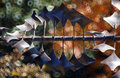
just curious if anyone has some (easy) techniques for creating the background light spots for bokeh photography? i know to use shallow DOF to get the blur, but how to get a "sea of small lights" in the background in the first place??
strings of christmas lights?
paper with holes in it and a light behind it?
what have YOU used or can you think of to get that effect?
Background light spots are not a crucial, nor essential part of good bokeh. It can be a contributing factor to a pleasant bokeh, but it is not the only factor which comprises a good "bokeh". Furthermore, absence of "light spot circles" does not preclude a quality bokeh.
Highlight off leaves while shooting into the light, sparkles off water, house lights in the evening. will all make those CoC (circles of confusion).
Look for a background with high contrast in a mottled field, and you will get the circles. One bit of warning, if you are going to fake it with a string of lights and it looks out of place, expect some bad reactions. If it works, well, good on you. If it's easy to spot, beware the wrath of the anonymous voter.
I found a very nice article by Ken Rockwell on boken. What it is, what some examples of good, neutral and bad boken. How to get it, and how to see it.Link
just curious if anyone has some (easy) techniques for creating the background light spots for bokeh photography? i know to use shallow DOF to get the blur, but how to get a "sea of small lights" in the background in the first place??
strings of christmas lights?
paper with holes in it and a light behind it?
what have YOU used or can you think of to get that effect?
many thanks!
-mefnj
1. First of all bokeh does not mean blurred circle in background. Bokeh simply means out of focus part.
2. There are two rules of thumb you can say:
a: Choose widest aperture. Example F1.4 at 50mm will give more blur than f8 at 50mm
b: longer lense length. (f1.4 at 100mm give more blur than f1.4 at 50mm)
Note in both the above statements it is assumed that camera to subject distance is same. (so framming will change with length of lense).
Example:
(These pictures are only 500 pixel wide, hope that it is not breaking TOS)
F1.2 at 50mm
Notice that there is sharp fouced area , then there is transition to out of focus parts.
Example 2:
F1.8 at 55mm (length changed this time)
Example 3:
Smaller aperture but longer length
F3.5 at 135mm
just curious if anyone has some (easy) techniques for creating the background light spots for bokeh photography? i know to use shallow DOF to get the blur, but how to get a "sea of small lights" in the background in the first place??
strings of christmas lights?
paper with holes in it and a light behind it?
what have YOU used or can you think of to get that effect?
many thanks!
-mefnj
1. First of all bokeh does not mean blurred circle in background. Bokeh simply means out of focus part.
2. There are two rules of thumb you can say:
a: Choose widest aperture. Example F1.4 at 50mm will give more blur than f8 at 50mm
b: longer lense length. (f1.4 at 100mm give more blur than f1.4 at 50mm)
Note in both the above statements it is assumed that camera to subject distance is same. (so framming will change with length of lense).
Example:
(These pictures are only 500 pixel wide, hope that it is not breaking TOS)
F1.2 at 50mm
Notice that there is sharp fouced area , then there is transition to out of focus parts.
Example 2:
F1.8 at 55mm (length changed this time)
Example 3:
Smaller aperture but longer length
F3.5 at 135mm
I hope this explains.
What also helps is to make sure that there's some distances between your subject and your background.