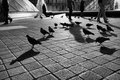
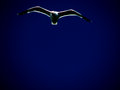
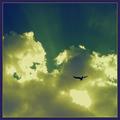
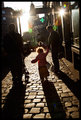
Here is a more complete wiki definition of Contre-Jour:
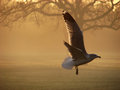
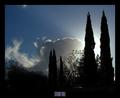
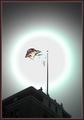
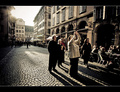
Contre-jour, French for 'against daylight', refers to photographs taken when the camera is pointing directly toward the source of light. An alternative term is backlighting.
Contre-jour produces backlighting of the subject. This effect usually hides details, causes a stronger contrast between light and dark, creates silhouettes and emphasizes lines and shapes. The sun, or other light source, is often seen as either a bright spot or as a strong glare behind the subject. Fill light may be used to illuminate the side of the subject facing toward the camera.
Not sure anyone else needs it but it helped me decide the shot I thought I would use is now out.
Hmmm, I'd mildly disagree, but I'd be open to a counter argument. :)
In that case, thank goodness it was not entered (and killed by the voters) in a Contre-Jour challenge. Probably the light from behind was not bright enough for your taste.
Hmmm, I'd mildly disagree, but I'd be open to a counter argument. :)
In that case, thank goodness it was not entered (and killed by the voters) in a Contre-Jour challenge. Probably the light from behind was not bright enough for your taste.
Exactly. I'm actually struggling with whether my potential entries qualify enough as the fill light is either too strong or the backlighting is not directly behind the subject. Both qualities lead it away from classic contre-jour, although it doesn't necessarily mean they don't count (the same with your picture).
Hmmm, I'd mildly disagree, but I'd be open to a counter argument. :)
In that case, thank goodness it was not entered (and killed by the voters) in a Contre-Jour challenge. Probably the light from behind was not bright enough for your taste.
Exactly. I'm actually struggling with whether my potential entries qualify enough as the fill light is either too strong or the backlighting is not directly behind the subject. Both qualities lead it away from classic contre-jour, although it doesn't necessarily mean they don't count (the same with your picture).
For me, to qualify as contre jour, the main light has to be behind the subject. The fill, if used, should be secondary. In this shot, the "main" light IS the "fill" light, to my way of looking at it.
For me, to qualify as contre jour, the main light has to be behind the subject. The fill, if used, should be secondary. In this shot, the "main" light IS the "fill" light, to my way of looking at it.
For me, to qualify as contre jour, the main light has to be behind the subject. The fill, if used, should be secondary. In this shot, the "main" light IS the "fill" light, to my way of looking at it.
R.
Red ribbon last go around?
I think he meant it within a backlighting context, something like "the light behind the subject should be the main light, because contre jour requires the main light to be pointed at the camera." Right, Bear?
For me, to qualify as contre jour, the main light has to be behind the subject. The fill, if used, should be secondary. In this shot, the "main" light IS the "fill" light, to my way of looking at it.
R.
Red ribbon last go around?
I think he meant it within a backlighting context, something like "the light behind the subject should be the main light, because contre jour requires the main light to be pointed at the camera." Right, Bear?
Pretty much. I meant it in an artificial light context. If you're gonna add so much fill, whether with a light or a reflector, that the fill becomes the dominant light, then it doesn't feel like contre jour to me. But that's just my opinion. The referenced snowscape, on the other hand, is a classic contre jour landscape.
By definition, contre jour refers to pointing the camera directly at the light source. It's simple. We're making it complicated.
Wah! No jour to contre this week here - been cloudy all week except yesterday and I had sick cats all day yesterday. I can't do contre jour with fake light. Wah!!!
Keep the sun out of the frame
Keep the sun well out of the frame when
shooting backlit subjects. Sunlight
focused into the camera when the sun is
in or close to the frame could cause a fire.
Do not look at the sun through the viewfinder
Viewing the sun or other strong light
source through the viewfinder could
cause permanent visual impairment.
A bit like the warning on the side of a McDonald's Coffee cup: