"The darker stage of twilight"; "dusk" originally "dark";
Ergo, to answer your question, likely somewhat after sunset. I wouldn't look at my watch but at the light.
It may be sunset here and dusk 500 ft north of here...
If you go to the weather underground, type in your zip code in the top leftish, then scroll down to "astronomy" toward the left side, it gives you sunrise and set, civil, nautical and astronomical twilight. That should give you a good idea, at least.
eta; of course your terrain will make a difference. If you're in the shadow of a hill it's gonna get dark a lot sooner :)
in the past month we have killed because this is an ongoing problem for years and have tried many different things.....40 bats IN OUR HOUSe............so the thought of a vampire is not that far off..........lol so when I see the bats flying that would also be considered dusk?
in the past month we have killed because this is an ongoing problem for years and have tried many different things.....40 bats IN OUR HOUSe............so the thought of a vampire is not that far off..........lol so when I see the bats flying that would also be considered dusk?
Not unless they transform, or are seen reading "Twilight"
"Dusk" is a subdivision of twilight, the darker part. "Twilight" is the time between sunset and absolute darkness, or between absolute darkness and sunrise. "Nautical twilight" is the last (or first) visibility of the horizon at sea, and represents the beginning (or the end) of darkness, so nautical twilight basically is the very end (or the beginning) of dusk. It's all subjective, though. These aren't precisely defined terms.
For what it's worth, bats fly around at dusk for sure :-)
Actually Robert, *ahem*, they are precisely defined terms. Civil twilight is from sunset to when the sun is six degrees below the horizon. Nautical twilight begins when the sun is six degrees below the horizon. Astronomical twilight begins at the end of nautical twilight when the sun is twelve degrees below the horizon. Darkness begins at the end of Astronomical twilight when the sun is eighteen degrees below the horizon.
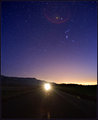
You can use programs like Stellarium or The Photographer's Ephemeris to see when various twilights begin where you are. I have found that interesting colors in the sky can be had by shooting at the beginning of astronomical twilight while still having a lot of stars in the sky. Here's an example (to the naked eye the sky is already seen as "black"):
Actually Robert, *ahem*, they are precisely defined terms. Civil twilight is from sunset to when the sun is six degrees below the horizon. Nautical twilight begins when the sun is six degrees below the horizon. Astronomical twilight begins at the end of nautical twilight when the sun is twelve degrees below the horizon. Darkness begins at the end of Astronomical twilight when the sun is eighteen degrees below the horizon.
You can use programs like Stellarium or The Photographer's Ephemeris to see when various twilights begin where you are. I have found that interesting colors in the sky can be had by shooting at the beginning of astronomical twilight while still having a lot of stars in the sky. Here's an example (to the naked eye the sky is already seen as "black"):
Well, yeah, I guess in that sense they are, but I was speaking more colloquially; the terms get bandied around a lot, among sailors especially, and are kind of fluid. But you're absolutely correct, of course, in that civil, nautical, and astronomical twilight all have precise meanings in almanacs and in the ephemeris.
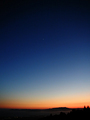
I have found that interesting colors in the sky can be had by shooting at the beginning of astronomical twilight while still having a lot of stars in the sky.
Before you look, guess what camera I used to capture this. That's Venus shining out of the upper part, and you can make out the San Francisco Bay waters in front of Mt. Tamalpais near the bottom.