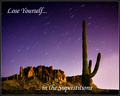
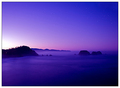
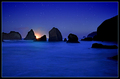
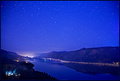
I'm really sorry if this is already up in a forum. (im sure it is but its almost 1am so I was hoping to not have to go looking for it. :P) What settings are best for getting pictures of stars? When ever I take pictures of the sky I see a big black mass of nothing. I have a canon S5 IS and am just learning how to work it. So can anyone tell me what my settings need to be to get a good picture of stars and or moon. Thank you in advance.
Check out the tutorials Here and Here.
Anything further, ask away.
ETA: You might have some trouble due to limitations on your shutter duration, but I'm not sure what your max shutter is. Also, find somewhere with a low value on the Bortle scale and you will have an easier time getting a capture.
Bortle Scale ETA US Map of Light Pollution If you dig you should be able to find a more localized map for yourself. It should help because your ambient light level will be lower, so each stellar body will have more contrast to the "space" around it.
Also, my apologies if you aren't from the US. No location in your profile.
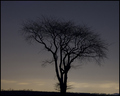
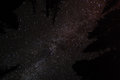
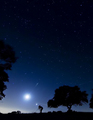
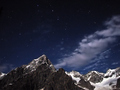
The silhouettes should appear like that as long as there is no lighting between the camera and them, because the camera meters for the background. Just like if you try taking somebody's photo with the sun behind them... camera meters for the intense sun, person becomes black. Same principle. If you get into the middle of nowhere you see a whole lot more though. This was taken in the Rawah Wilderness, Colorado. 92.8 sec shutter, ISO 1250 (though it could have been lower because my EV comp. was at -.7, unbeknownst to me).18mm. 10,900 ft elevation and a 7 mile hike in and 40 miles from any real city. This gives an idea how much more you can see when you're isolated. Assuming your photo is tagged correctly, Utah has some PERFECT areas for seeing lots (low light pollution).
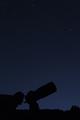
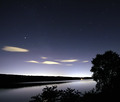
Well after i FINALLY found my (rather my brothers) clip to the tripod I decided to go see what i could get of the sky in my own yard... this is what i got (any comments/tips.) I still need help they arent turning out as great as I would have liked..... *thinks to self* how do i put a picture up again?... lol can someone tell me how I can put a thumbnail of pictures on my hard drive up onto a forum? thanks.
Getting night shots is tricky since the camera usually can't meter and give you any useful info. It's partly trial-and-error, but the formula is something like this: open aperture, moderate ISO, several seconds of exposure.
In your case, with the S5, I'd leave the lens zoomed to it's widest, which should also give you your largest aperture (f/2.8?). From there, try a 8 sec. exposure. If it's too bright, use less time. Not bright enough, use more time. If you reach 15 sec. without getting what you want, kick the ISO up another stop. (I'd start at ISO 400, since the higher you go, the more noise you'll have.)
Another thing to keep in mind - if you're using the S5 on the tripod, turn the IS feature off. I imagine the IS works the same built-in as it does on a lens, where mounting it to a tripod can confuse it and make it try to kick in when it's not needed, resulting in blurred shots.
Feel free to browse through my Astrophotography portfolio - I should have shooting data for most of the shots there.
Just remember you can bring stars out fairly well in Photoshop. If you don't want trails you need to be able to take a shot of 30 seconds or less. The more your zoom the more exaggerated the trail will be. Also the more your shot is away from the north star.
mpeters that first one is AMAZING very cool. So i am now FINALLY going to... (hopefully) post my pictures now they will look like nothing cause its just the sky no backgrounds/foreground I guess? like all the others on here but let me know what I can do to make them better..
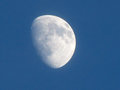
I tried two different ways to get rid of noise with the Moon at night. one I used the "stacking" and the second one I used Good old Noise Ninja.
Just remember you can bring stars out fairly well in Photoshop. If you don't want trails you need to be able to take a shot of 30 seconds or less. The more your zoom the more exaggerated the trail will be. Also the more your shot is away from the north star.
Great shots Doc. I need to ask. Did you omit something in the last sentence of your post? The more your shot is away from the north star....
The less trails you'll get or is it the opposite? I'll be doing lots of night shots this winter and I would like to know what you wanted to say, or am I still asleep this morning and didn't get point.
The less trails you'll get or is it the opposite? I'll be doing lots of night shots this winter and I would like to know what you wanted to say, or am I still asleep this morning and didn't get point.
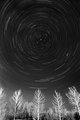
Sorry, I probably wasn't clear. Stars close to the north star will not trail much because they don't move that much over time. The further away from the north star you point your camera (assuming you are only shooting a portion of the sky and not a really wide angle shot) the more trailing you will get because those stars move more over the same period of time.
mpeters that first one is AMAZING very cool. So i am now FINALLY going to... (hopefully) post my pictures now they will look like nothing cause its just the sky no backgrounds/foreground I guess? like all the others on here but let me know what I can do to make them better..
I tried two different ways to get rid of noise with the Moon at night. one I used the "stacking" and the second one I used Good old Noise Ninja.
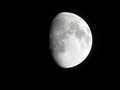
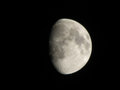
The moon shots are nice--but totally different animal than stars. The relative brightness of the moon necessitates shooting it at a relative fast speed/small aperature. I've had little success shooting the moon so I can't give you many pointers.
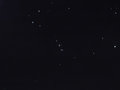
What were your camera settings on the star shot you posted? It looks like a zoomed in shot of a very dark night sky. Seems to show a little camera shake as well.
The less trails you'll get or is it the opposite? I'll be doing lots of night shots this winter and I would like to know what you wanted to say, or am I still asleep this morning and didn't get point.
Sorry, I probably wasn't clear. Stars close to the north star will not trail much because they don't move that much over time. The further away from the north star you point your camera (assuming you are only shooting a portion of the sky and not a really wide angle shot) the more trailing you will get because those stars move more over the same period of time.
here's a visual example of what the doc said so well ;)
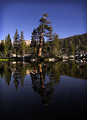
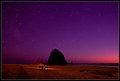
Best night stars shot settings that work for me are 30 sec shutter on self timer w/mirror lockup enabled and 400 ISO. You'll probably not be able to see all the stars clearly until post-processing. USM and sharpen will define the stars better. My best sample of this method is the following image, a cable release was used in this case.
Best night stars shot settings that work for me are 30 sec shutter on self timer w/mirror lockup enabled and 400 ISO. You'll probably not be able to see all the stars clearly until post-processing. USM and sharpen will define the stars better. My best sample of this method is the following image, a cable release was used in this case.
Nice shot. I'd question though whether the mirror lockup is doing much for you.