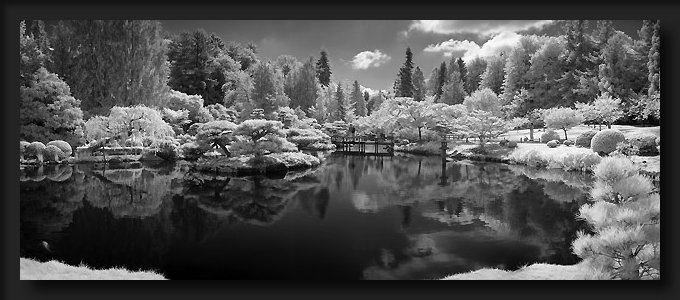
Yep, infrared filter and pretty long exposures. Most DSLRs have very efficient "hot mirrors", so they are relatively insensitive to IR light. With a very near-IR filter, the performance is certainly usable, but a tripod is pretty much a requierement.
I never really understood why this was so popular? to me the results just look like you took a black and white picture and set it to negative or something. is there anything that it's actually useful for?
I never really understood why this was so popular? to me the results just look like you took a black and white picture and set it to negative or something. is there anything that it's actually useful for?
It's only "use" is to please people. It doesn't please everybody, but some people like it alot.
Here's a recent attempt I had at infrared photography. This is a colour IR shot BTW.
Like kirbic said, IR filter and long exposures, on a tripod obviously. Personally, I like it alot. I just wish my DSLR was a little better at it. You really have to push the 20D to get IR shots. Some cameras can do it, handheld at decent shutter speeds.
Two questions regarding IR digital photography:
First, can you use a dark red filter instead of the usual Hoya 72?
Also, what kind of PS post processing is performed to get the IR effect?
Originally posted by kyebosh:
I never really understood why this was so popular? to me the results just look like you took a black and white picture and set it to negative or something. is there anything that it's actually useful for?
I use B&W traditional screw in filters or gel filters (both 87c) that allow no visible light to reach the sensor.
ISO set to 400 to keep exposures from getting too long, but much better quality than higher ISOs.
I shoot RAW files to keep exposure latitude at the processing stage.
Aperture between f8 and f16. To balance between focusing errors and diffraction softness. At f8 and closer than infinity I adjust focus slightly closer than typical focus.
If I am using the D70 kit lens at 18mm or my 14mm lens I "cheat" by framing with my voightlander rangefinder viewfinders (28mm & 21mm respectively). This keeps me from having to take off the filter everytime I want to reframe.
I meter in center-weighted mode with the filter on. Be sure that the eyepiece is completely covered or the exposure will be compromised. Exposure times are usually around a couple of seconds during bright midday sun. (That is another reason to shoot infrared. Its best when traditional photography is at its worst.)
Although I've been shooting infrared film for almost 20 years, I’m no expert at Photoshop. (Infrared is why I finally bought a digital camera for other than casual photography), My technique is to play with it till it looks good so I’m not much of a help at the computer stage.
I never really understood why this was so popular? to me the results just look like you took a black and white picture and set it to negative or something. is there anything that it's actually useful for?
Many black and white photos leave me cold.
However, infrared has a dreamlike magic to it that I love.
Here's a link to an infrared photography page, though its based on a Canon G-series camera: Infrared Photography Techniques. I think at least some of the tips probably translate.
Now, I don't know if this translates to DSLRs, but apparently there is an infrared filter (hot mirror) built into most digital camers. This is to improve regular photos, but apparently makes infrared photos difficult. To create the "ultimate" digital infrared camera, you can remove that filter, as described here: G-series Infrared Conversion. Again, its G-series related, but if you're gutsy and have a spare camera you don't mind dedicating to infrared photography (aparently, there's no turning back!), then it might be a worth-while endevor. :)
hyperfocal, thats a great example thank you. so just 2 87C filters and go from there eh? i did see the link about taking the mirror out of my D70, but i dont want to even THINK about potentially screwing up the camera :-)
Sony cameras with "night shot" capabilities are able to remove the internal 'anti-infrared' filter so a typical infrared shot takes less than a second of exposure at 100 ISO. Many people get a F717, V1, 828... just to take IR shots without the need to remove the filter in the 'hard' way.
For example this one used ISO 100, F2 at 1/60:
BTW, is someones wants to give a try at IR images without the need to buy an expensive IR filter (hoya R72) just use instead two or three layers of develoved photo film in front of the ND filter. It works quite well. Of course the format of this film should be one such that it covers all of the lens surface.
To me the results i'm getting are good enough that I wouldn't do it (the D70 conversion). I was thinking about having it done to my D100 (about $500 commercially) since it is about worn out, but I think I'll skip it for the same reason. I played around with my father-inlaw's Minolta Dimage 7, and it looked awesome. It is alot more sensitive in that range than the Nikons. I'm thinking about trying to find one on e-bay, however I'm so used to working in the NEF format it would probably throw off my work flow.