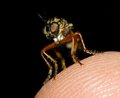
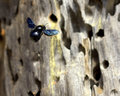
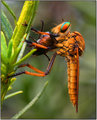
My question is: are these brilliant close-ups a product of crazy setups (lens + extensions, or lens + reverse lens), or is this possible with standard macro lens?
Second question, while I know the longer focal length macros like 150mm and 180mm give you longer working distance, I "assume" they still only give you 1:1 like a 100mm macro lens? Thus one lens doesn't get you "in any tighter" than another?
Some beautiful macro work there, to be sure. All of it is at very high magnification, definitely higher than 1:1. You are correct that most macro lenses reach only 1:1 without some additional assistance/ On APS-C, this gives a field of view of about an inch. The Canon MP-E65 goes from 1:1 on the *low* end to 5:1 on the high end. It is for macro only, however,and will not focus to infinity (or even to 1 foot, LOL).
I had some trouble finding any references to his technique on a short search, but it does seem that he uses focus stacking, another almost necessary technique at these magnifications. In the end, if you can get results anything like he does, you can say you have really mastered macro photography. It is a difficult, challenging, but ultimately rewarding area of photography.
Yep. Magnification looks like at least 2:1, probably higher, although even 1:1 on a small-sensor camera can look like a lot more. For comparison, this:
was shot at just over 2x, and is still cropped significantly.
In other words, with a dense enough sensor those kind of results might be possible with a regular 1:1 lens, but you'll need to crop to get there with any level of usable DOF.
I am by no means an expert. I have been shooting bugs for a few months.
I originally had a Nikon D7000 and had pretty good results initially with a manual 105mm and eventually I bought the latest AF version which gives you 1-1 magnification and migrated to the D7100 because of the higher pixel density and the absence of the low pass filter. I debated the upgrade for a while but I think it was money really well spent.
I tried the reversed lens with extension tubes but I have not had much luck with it, probably because of my own limitations but I found it really hard to do.
Some of the pictures I have been able to get are here:
drgoose68 flickr Since you are a Canon guy you have the advantage of having available to you the Canon MPE-65 lens that can give you a magnification of up to 5:1.
Apparently not an easy lens to use.
Out of all the types of photography I have given a shot at, macro is by far the one I have had the most fun with.
Hope it helps. Have a blast.
Ditto on the Roz is amazing.
A bellows can get you deep into macro territory with a normal manual lens, but it's a bit of a trick to get adjusted to using it effectively. It's essentially a variable/ zoom extension tube.
A short lens like 24mm can get right in there with even a short extension. The longer lenses require longer extensions to get to the same magnification.
Or, you can "roll your own", starting with any old simple lens if you are handy with duck tape and hammers. This one cost me less than $25 total, and about 30 minutes with a lathe.
Stupid question #7. With extension tubes, do you lose any extra stops of light?
Yes. Two stops for every doubling of magnification. When you double the magnification, you are spreading the same quantity of light over four times the area, thus two stops of loss. You do gain something in return, though. The effective f ratio gets numerically larger, so the DoF increases. This effect is why the Canon MP-E65, though labeled f/2.8, actually has an effective f number of f/5.6 at 1:1, and f/96 at 5:1 (yes, that's f-ninety-six!), even though the camera reports f/2.8.
Can you help me here. If I start with a 100mm lens with 1:1 ratio and add a 12mm or 20mm or 36mm extension tube, how do I calculate what the resultant magnification would be?
Can you help me here. If I start with a 100mm lens with 1:1 ratio and add a 12mm or 20mm or 36mm extension tube, how do I calculate what the resultant magnification would be?
My opinion: unless you've got a handle on the light with macro photography, don't go chasing after more magnification. Things get complicated very fast in that realm (effective aperture, focusing, etc.), so if you want to keep life easy, start with the basics.
Only my opinion, of course, but i've made the same mistake :)
The effective f ratio gets numerically larger, so the DoF increases.
Is that true? I always thought that you're losing light without gaining DoF.
The DoF is larger than what you'd expect based on the reported f number, but since the magnification is increased, that does offset it. The end result is still damn narrow DoF! The bottom line is you need to use the effective f number when calculating DoF, and DoF for macro is a different calculation than for normal work, because terms in the equations that are negligible near infinity focus play a large role at macro distances.