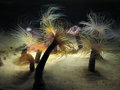
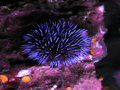
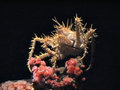
i went to the aquarium for the fourth time this year today.
Nothing, not a single shot worth keeping. Well maybe the crocodile and frogs but they don't count.
the combination of low light and moving fish is just impossible to capture. tripods are worthless since long exposures don't work, high iso are noisy, wide apertures are impossible to maintain focus on the fish. flash just ruins it all, even the combination of a long exposure and high iso shots in post dont works since the don't blend well due to noise...
How high was your ISO shooting wide open with the 50mm 1.4? I've not tried to shoot fish before except as a backdrop for a fashion photo shoot at an aquarium. If you have good lights and can get permission to use them you shouldn't have much problem getting good shots if you have good power lights. Might be more difficult with speed lights since you'd probably have to shoot bare bulb which will probably scare the fish and limit your ability to angle them just right.
ok, so i'm being a little over dramatic, i have had ONE shot turn out in all the times i went. I love aquariums the colors, lighting all seem to make great images but when i try to capture any of it... it just doesn't turn out as well as i hope.
really the species in the exhibits themselves arent incredibly difficult to capture, its creating an image like skip posted with people in them or creating a view showcasing the experience that i just cant seem to get.
The thing about aquariums is they are dark (obviously) so expect to get photos where the histogram weighs heavier on the left. This is fine because you'll expose for the brightest points and the image will look very natural.
Work at higher ISO and expose for the highlights. There won't be many, but enough.
Have you subjects sit still.
I've switched to a "pistol" like grip with my right hand on the right of the camera, finger on the trigger and my right hand cupped with my left. This will give you a more steady shot and give you more leeway on your exposure.
Post process, develop the shadows. Shoot RAW so you have more flexibility over the white balance and other settings.
Finally, (although this is foremost) situate your subjects in a manner that uses all the available light. Often, there is a LOT of light coming from the tank and surrounding mini-spotlights. Use it to help light the faces.
I have a shot where my daughter was at the touch tank. I put her near one of the lights so I could get some shots. It was still quite dark in this area and I had to revert to ISO 1600, f/2.8, and 1/40s. I waited until she was still and got a nice crisp shot that was well exposed.
Tank shots are different. First, you need a faster shutter usually because fish don't pose. Except maybe for eels, turtles, and some lizards. :) Though, I've gotten some decent shots as low as 1/40 on a moving fish. If you are forced to shoot slow you may need to pan. I find that manual focusing works better because you have fine control on the focus without changing the composition.
That's all I have off the top of my head.
Originally posted by mike_311:
really the species in the exhibits themselves arent incredibly difficult to capture, its creating an image like skip posted with people in them or creating a view showcasing the experience that i just cant seem to get.
I was at an aquarium a couple of years back, shooting high iso, no speedlight (signs up everywhere that flashes can kill the fish etc.)
But one of the staff came over to me and said she had a problem with the *focus light* going off. So I turned off the focus light and had to manual focus everything... which made the job considerably more difficult.
Interesting...particular type of fish maybe? At the one I go to there are no restrictions at all. Its funny though, when I see someone pull out their P&S, flash on, kids in front of the tank and the person square. Then, they look at their camera and wonder why it doesn't look so good. :)
Originally posted by JH:
I was at an aquarium a couple of years back, shooting high iso, no speedlight (signs up everywhere that flashes can kill the fish etc.)
But one of the staff came over to me and said she had a problem with the *focus light* going off. So I turned off the focus light and had to manual focus everything... which made the job considerably more difficult.
Actually, at that point I stopped taking photos. I thought 'what's the point? - If I want good clear photos of the fish, I'll buy a postcard book in the gift shop'
And I proceeded to actually enjoy the rest of the day, instead of worrying about camera settings :)
Alot has to do with the angle you take the shot at.
You can use the flash if it's not going to bounce right back at you.
I took this with a flash from a low angle and the flash bounce up and over my head. I think I used the 55-200, stood back and zoomed in.
This was at my house so it a bit different, it was quiet and I was able to take lot of shots.
While on a photo excursion withBear_Music a few years ago I got what I thought were some decent shots at the Monterey Bay Aquarium. They don't allow flashes, but I think it's more to do with not ruining the environment for other vistors than animal safety. My camera REALLY sucks at high (>200) ISO, so I'm sure I had to under-expose these somewhat and lighten them in post-processing, but I don't seem to have the exposure details listed ... :-(
Things I've found helpful:
• with moving fish, treat like sports photography: prefocus on the place where the action will occur (or where where the best light is) and wait for the subject to swim into the frame
• Get right up against the glass to minimize reflections. If you can shoot with the lens flush against the glass you can use the pressure to steady the camera and enable longer exposures without camera-shake
• Bring a soft cloth to remove finger- and nose-prints from the glass before resting your lens against it
• a polarizer will lengthen exposures, but may help with reducing reflections
We're planning on hitting the aquarium while in gatlinburg. hopefully I'll get some decent shots. don't have to be mindblowing... though it would be nice. lol
Both times I went to the big aquarium in Okinawa, I took a square of black foamboard with a round hole cut out in the middle for my lens. It really cuts out reflections on the glass when you hold the lens close to the tank.
Both times I went to the big aquarium in Okinawa, I took a square of black foamboard with a round hole cut out in the middle for my lens. It really cuts out reflections on the glass when you hold the lens close to the tank.
Another method is to make an open-topped cone of black paper, with the opening at the top just big enough to accomondate the lens. You can place the base of the cone against the glass and block out any light which might create a reflection.