thats what i assumed and i tried that. it doesnt seem to work so close up, i can get great star bursts of lights from far away, but not this close, at least not this noticeable.
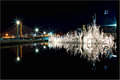
You don't need a star filter or a specific aperture, pretty much any long exposure with clearly defined light sources will produce this result I think, e.g.
I achieved with an aperture of f/22 and an exposure of 30 seconds.
What will make a difference to the stars is the exposure length (the longer the exposure, the larger the stars), how many aperture blades a lens has (iirc it works similar to bokeh, an even number of aperture blades will produce the same number of star points, an odd number will produce double that) and also what aperture you have the lens set to (this really requires experimentation I think, but at certain apertures the blades line up well and produce nicely defined stars, at other apertures the blades don't tend to line up so well and you get 'messy' stars with many points).
edit: just realised the stars in this image have only 4 points though and since I don't know of any lenses with 4 aperture blades I guess a star filter would be the way to go, unless you can cut out a square and place it over the front of the lens (much like you can make custom bokeh shapes). I'm not sure if this would work though.
You don't need a star filter or a specific aperture, pretty much any long exposure with clearly defined light sources will produce this result I think, e.g.
I achieved with an aperture of f/22 and an exposure of 30 seconds.
What will make a difference to the stars is the exposure length (the longer the exposure, the larger the stars), how many aperture blades a lens has (iirc it works similar to bokeh, an even number of aperture blades will produce the same number of star points, an odd number will produce double that) and also what aperture you have the lens set to (this really requires experimentation I think, but at certain apertures the blades line up well and produce nicely defined stars, at other apertures the blades don't tend to line up so well and you get 'messy' stars with many points).
edit: just realised the stars in this image have only 4 points though and since I don't know of any lenses with 4 aperture blades I guess a star filter would be the way to go, unless you can cut out a square and place it over the front of the lens (much like you can make custom bokeh shapes). I'm not sure if this would work though.
Actually Slippy is right. The smaller the aperture the better the result. f/22 usually works very well, as it did in your shot.
I didn't get to try it yet, but a long time ago I used to put a piece of window screen between 2 uv filters and it created stars. That was with film, I assume it would work with digital as well.
I took a photogrphy with the star filter I have and here I am seeing that each point of star has color variation and not simply show as star. not sure what is missing but help me to understand if this has anything to do with star filter.
if you look at the one here, I am looking for something like this and not the one that I have!!