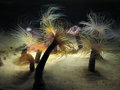
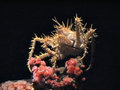
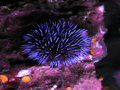
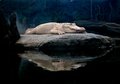
I'm planning on making a trip to the local aquarium and taking some snaps of the fish. Is it possible to do without a polarizing filter? Obviously my main concern is eliminating reflections off the glass. Can I do this without the filter, or is it a lost cause?
It can be done but it takes both skill and some luck ... I think some of my "best" pictures were taken at the Monterey Bay Aquarium when I went with Bear_Music nearly three years (!) ago.
I think the hardest thing is to find a position where you can avoid spot reflections of the room lights ... sometimes I try and set the edge of the lens right on the glass -- also can help steady the camera during those longish exposures. Being able to shoot at a high ISO without objectionable noise will help a lot -- it's one of the severest limitations of my camera. :-(
Try getting a large silicon rubber bowl from the kitchen department, cut out the bottom, and zip-tie it to your lens as a lens hood. Hold the bowl against the glass and it will make a seal that keep all the reflection producing light out. By using a decent sized bowl, you have some room to move the camera and follow your subjects.
Try getting a large silicon rubber bowl from the kitchen department, cut out the bottom, and zip-tie it to your lens as a lens hood. Hold the bowl against the glass and it will make a seal that keep all the reflection producing light out. By using a decent sized bowl, you have some room to move the camera and follow your subjects.
Definitely need a lens hood of some kind. Plan on it being kind of dark. Also, at the Denver Aquarium there were tons of kids. Maybe not so bad with school starting back up.
I made up a mega hood out of an old black tee shirt and some wire (9 inches wide at the front), one end slips over the back of the lens hood, the other is a loop big enough to hold the fabric out of the frame, and the middle coils out to keep the fabric from drooping into the frame. When flat it looks like a spiral with circular ends, with the fabric stapled to the circles. When in use it lets you make a flexible cone of darkness that gets rid of reflections.
It also pays to keep a cloth and a little eyedrop container of windex to clean off the finger prints for a portal of clean glass.
And when all is said and done, when processing, keep in mind the wide USM trick to get rid of the glass haze that crops up dispite your best efforts.
I think he means using the Unsharp Mask filter with a high-radius -- it acts like the "clarify" filter to improve contrast and get rid of that "hazy" look ... try it on a "flat" landscape. Be careful because it can also blow out highlight detail and block up shadows.
For a DPC-entry sized image try applying the USM filter with these settings (Photoshop lingo):
Amount: 15%
Radius: 50 pixels
Threshold: 0
Ill try to dig it out when I get home, but the wide USM is inverting the usual USM numbers using an amount around 18% with a radius of between 40 and 80 pixels. This brings up local contrast, getting rid of haze, be it atmospheric (like a smoggy or hazy day) or from shooting through glass(made hazy from the oil of many little fingers).
Here's two from our most recent California trip, shot at the Monterey Bay aquarium:
Neither used a polarizer or any sort of special hood. I was mostly too far from the glass to use a Brennan-type hood, though I've used them in the past to do shots from behind glass when doing architectural photography. Aquariums, as a rule, are too dimly lit to make using the polarizer a good idea.
I use a board of black foamy type material (don't know the technical name of it) which I bought at the ¥100 shop. In the centre of it, I just cut a hole a little larger than my lens diameter. Certainly cuts out the spot reflections.
Ill try to dig it out when I get home, but the wide USM is inverting the usual USM numbers using an amount around 18% with a radius of between 40 and 80 pixels. This brings up local contrast, getting rid of haze, be it atmospheric (like a smoggy or hazy day) or from shooting through glass(made hazy from the oil of many little fingers).
It does take practice. And a flash really, really helps (not the on camera flash). I try to aim the flash straight above what you're shooting (it hits the top of the water and diffuses) so it doesn't show up in the picture. And get as close to the glass as you can. Most of my better aquarium shots the lens hood is against the glass.