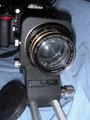
If they say Series 1, they are probably very good glass for their day. Series 1 was Vivitar's top of the line professional glass.
The real question is, what mount do they have? That will determine whether they will be usable or adaptable to Canon bodies.
I have a Vivitar 28-105mm f/2.8-3.8 Series 1 (macro) with a Nikon mount that I use on my Canon cameras (with a cheap adapter ring). It is a very sharp and well built lens. It was a little difficult to use with the digital rebel (focusing), but pretty easy with the 50D especially in live view.
it would just go on the camera so i can fit it on my 40d. Im sure you can take it off and use it with film bodies again, if I had one...
OK, but we need to know what mount is on the lens *now*. Vivitar made lenses for several different SLR systems, which were these lenses intended for?.
Some are easy to obtain Canon adapters for, some not so easy, and some are impossible without changing the mount on the lens directly.
I have no idea how to tell what mount it is really.
Can you ask the person who gave them to you what kind of camera they fit? Another approach, take pictures of the mount and post them. We may be able to identify the mount.
The adapter ring I purchased was a cheap one off ebay (about $15.00 I think). I have 3 Nikon lenses and I simply move the ring from lens to lens. It is similar to this on at Adarama.
You might can spot your lens mount type on this site.
OK, so it's a bayonet mount; I can't conclusively identify it, but it could be a Nikon F mount, but if it were I'd expect to see a "tab" for aperture control. It could also be an Exakta/Topcon mount.
In either case, it should be possible to adapt the lens to Canon EOS mount. It's easier if it's a Nikon mount. My experience with some of the Exakta to EOS adapters is that infinity focus may not be fully realized with some lenses if the adapter is not carefully made.
I'd take one of the lenses to a camera store and compare it carefully to a Nikon lens. Depending on the store, if they have someone with experience on staff, they may be of service in conclusively identifying the mount if it is not Nikon.
Ah, I missed the aperture control tab before. Looks in the right place for F mount. If I am correct, any decent camera store can help you confirm it. If it is F mount, then all you need is a Nikon-to-EOS adapter ring such as jasonlprice linked to earlier.
In use, you will need to set aperture manually via the ring on the lens, and of course focus will be manual. Your camera will function either in full manual (M) mode, or in Aperture Priority (Av) mode. Either way, be aware that no aperture info will be recorded in EXIF.
cool thanks a lot! I think im going to just start looking for more and more older glass. I just want a different approach for a while.
You'll have a lot of fun with that. The really nice thing about the Canon EOS system is that it is the most adaptable modern SLR system in terms of the lenses it can accept. The reason is the relatively short "register distance," that is, the distance from the lens mounting flange to the sensor, and the large lens mount diameter. That combination means that many older lens mounts can be adapted to fit EOS mount without losing infinity focus. Some of the notables include Nikon F, M42 screw mount, and Exakta.
One thing to b e careful of wtih Canon full-frame cameras, especially the original 5D, is mirror interference. If the old lens extends far into the body, the mirror may hit it when it flips up/down. This is not often a problem with the Canon APS-C cameras, because the mirror is smaller.
In retrieving some old boxes from Seattle I've unearthed a handful of lenses I haven't seen in a decade and half and I'd like to play around with them, but am not sure if any modifications need to be made. I'm aware all would be manual aperture and focus.
You should be fine with this one at least. I think it was ai when it was introduced in late 70's so there aren't any pre-ai that would damage your camera. So it will either be an 'ai' or an' ai-s' both of which will mount fine on the D700.
It is meant to a fantastic lens. I have the slightly different Micro-NIKKOR 55mm f/3.5 ai and i love it. It's stupidly sharp and just a pleasure to use. I think this is the only image on DPC i have from it.
With the older manual Nikon glass, be sure that the lens is an "Ai" or "Ai'd" lens before trying to mount it on your current Nikon or Fuji DSLR. The earlier "Non Ai" lens mounts are easy to identify, because the back edge of the aperture ring (with the f#'s on it, ) are smooth all the way around. Generally, the older Nikkor lenses have the "rabbit ears" on them. The Ai versions have holes in the two, bright metal, rabbit ears, and the back of the aperture ring is machined with notches so that the aperture ring moves a little lever on the body near the lens mount. This lever can be bent if a "Non Ai" lens is mounted on a current Nikon.
Some of the older extension tubes are made so that the outside edge of the mount does not extend past the flat "land" of the mount in front of the mounting flange. The older "Non Ai" lenses can be mounted on the ext tube and used with the current cameras. An example would be the "M3" ext tube.
If you have a connection to a good repair shop, they can probably do an "Ai" conversion on the older lenses for you. If you are handy with tools, and understand how it works, you can do it yourself. I have converted several of my old "Non Ai" lenses using a Dremel tool and small files.
The Nikon mount is easy to identify due to the radial slot on the left side of the flat part of the mount that a little pin on the body engages to lock the lens on to the camera, and the aperture stop down lever being directly across from that slot. Most of the older ones still have the "rabbit ears" on them as well.
Here's one of the better websites illustrating many of the more common lens mounts. Click on the photo of the Nikon mount for more details.
Rick Oleson, Lens Mount Page
One more thing worth mentioning, is that with the manual lenses mounted on the Fuji S3, and many of the Nikon DSLR's shooting will be limited to either all "Manual" mode, or "Manual and or Aperture Priority" modes. I shot with the S3 Fuji for a good while using older glass, but had to use "Manual Mode" and estimate the exposure settings by chimping the first shots on the LCD. The "Blinkies" will help if you have to shoot all manual.
Thanks a lot, Waddy. I knew you'd have the answers!
I still got confused. I think the Nikkor 55mm is pre-Ai and in my impatience I put it on. It went on with ease and all seemed well, but the shutter release was a bit clunkier and louder than normal.
After a few moments of feeling physically ill thinking I had damaged the mirror or mechanism, I think it's OK. Subsequent shutter releases with my regular lens sound fine and the results are as they should be. The lever on the body is unbent and works fine when I put the extension tubes or my Ai lens on.
Don't know. Maybe I'm imagining the clunkiness of the shutter release. Or maybe I've really messed it up and haven't discovered it yet.
Either way, I'll proceed more slowly from now on. Thanks a lot for the great info.
I still got confused. I think the Nikkor 55mm is pre-Ai and in my impatience I put it on.
I really don't think that 55mm is pre-Ai. This is a good site for information on older Nikon lenses and it does seem that the f/2.8 was an update to the f/3.5mm and first came out in 1979 and is Ai- or Ai-s. You should be able to get the date from your serial number as there are websites which list them.
Here's the link to the blurb about Ai, Non Ai, and AiS Nikon mount.
Old Nikon Lens Mounts
The trick about it is that the back edge of the aperture ring on the lenses you shouldn't put on the current DSLR's has a smooth edge.
That would be the rear, outside edge of the lens. If it's smooth all around, don't try it.
If it has notches in it, places that stick up past the major part of the ring at the back, then it's Ai, and ok to use.
With the old ext tubes, most do not stick back beyond the main flat part of the mount, making them ok to use. Just pay attention to how they mount, and see that they don't push against the little slider/lever on the camrea's mount. I have used the "M" and "PK13" safely, as well as several from Vivitar and others. The Vivitar A3 set works well with the manual lenses because it was made for Ai operation and transfers the aperture info to the camera via the mechanical linkage. That makes metering accurate.
You may feel a little more vibration or hear more sound using the older lenses, due to the size of the mechanism that works the aperture when the shutter is released.
There are a couple of the older Nikkors that extend into the body deep enough to interfere with the mirror operation. They are listed in the manual that came with the camera. A couple that come to mind are a 21mm and an 8mm fisheye.
I'm not sure about other Nikons, but the D7000 has settings in the menus to input data for up to 9 different non cpu lenses. This allows the camera to record accurate info about the aperture setting in exif, and also helps with metering correctly.
When you are using manual / non cpu lenses, you will have to physically set the aperture using the aperture ring on the lens, since the camera is not connected via electronics to that function.
If you put the camera in the manual mode, it will shoot, using anything that will fit in front of it and make an image on the sensor. My oldest lens that gets used is patented in 1903, and I use it with a macro bellows setup so that I can focus it.